Product Marketing
How to Conduct B2B SaaS Customer Discovery Interviews
How to run the perfect B2B SaaS discovery interview: a six section, 30 minute structure, with fundamental questions and methodology explained.
-3.png)
Lamar Hendrikse
Customer research · Customer interviews
Customer interviews have always been one of the best sources of information a business has, and AI has made them more valuable rather than less. A model can summarize everything already written about your market, but it can only work with what someone has collected. What your customers think of your product has to be asked for first. Interviews are also hard to get right, and harder in B2B SaaS than almost anywhere else. Customer bases are often too small to sample. Purchases are rare, slow and complicated. And a buying decision passes through a committee of people, some of whose standing depends on how it turns out.
The Kalungi Interview Guide Series
This is the first guide in our series on customer interviews. It covers habits that work in any customer interview, alongside frameworks, rules, and specific questions that we use in five different types of customer interviews. Each customer interview type will get its own guide:
Interviews work best when supported by substantive survey and quantitative work. Key ideas are already covered in our piece on doing good customer research in the AI era, but more detailed guides on surveys will be forthcoming.
Our advice comes from the research and strategy work we do with B2B SaaS companies at Kalungi, with published research alongside it where it helps.
Why are Customer interviews in B2b Saas uniquely hard?
A consumer brand can interview forty shoppers and treat them as roughly interchangeable. A B2B SaaS company might have forty customers in total, and each of those purchases was made by a group of people who experienced it differently. Ask research firms how many people sit in a typical software buying group and the answers run anywhere from two to sixteen. The person you interview saw part of that decision, and will usually describe it as though they saw all of it.
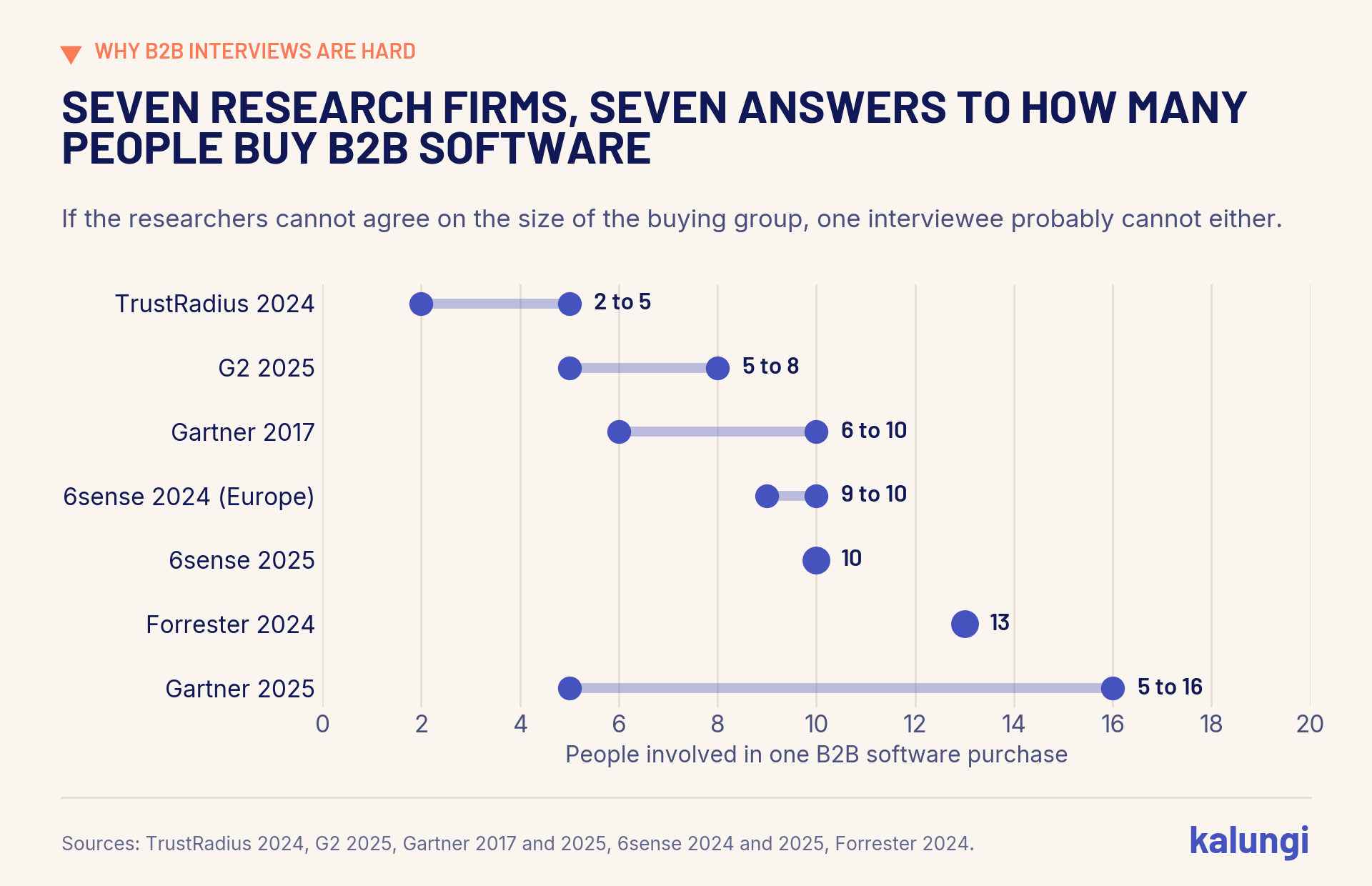 Each firm measured something slightly different, which is part of the point. Sources: TrustRadius 2024, G2 2025, Gartner 2017 and 2025, 6sense 2024 and 2025, Forrester 2024.
None of this makes interviews less useful. It means the way you ask matters more than it would elsewhere. Three principles should frame each question you ask, and four rules govern the call as a whole.
Our go to tips
Ask about something that happened. Not what someone would do, not how they generally feel, and keep the episode recent.
Don’t ask “How might you use our product in your analytics suite?” The problem is not that the question is vague. “Would our tool save you time in your export and analysis pipeline?” is more specific and no better. People are poor at predicting what they would do, and in a complicated decision they are worse at it still. In job interviews, questions about what candidates had done predicted their performance far better than questions about what they would do once the role was complex, and few purchases are more complex than B2B software.
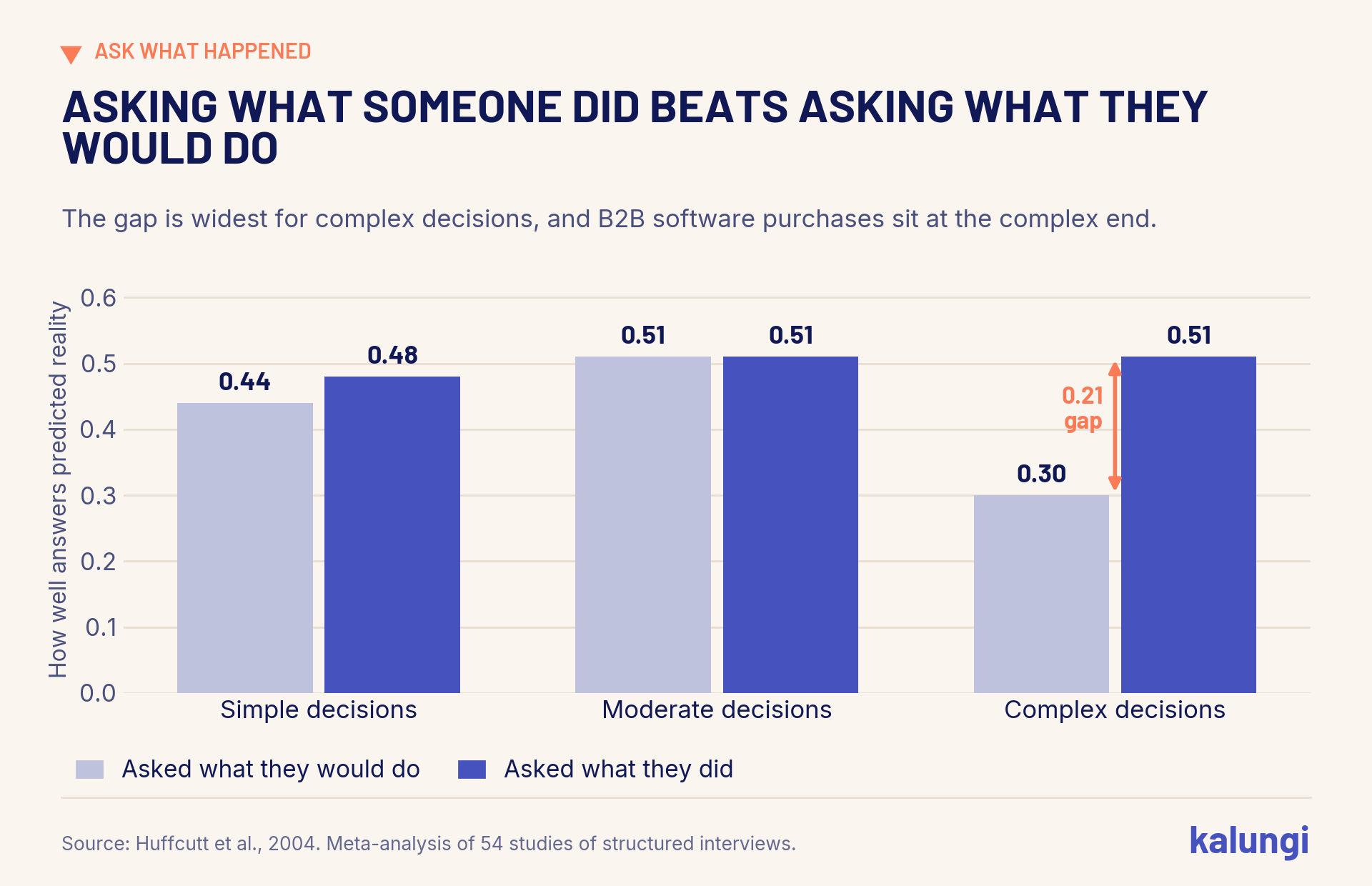 Source: Huffcutt et al., 2004, a meta-analysis of 54 studies of structured job interviews.
Memory has limits too, which is why the episode should be recent. When researchers checked households’ recollections against their purchase records, only 56 percent placed their own purchase in the right six month window (Morwitz, 1997), and accuracy fell the further back the purchase was.
So instead of “Would our tool save you time with your export and analysis pipeline?”, ask “How do you export your reports today? Where does it slow down, and what do you do when it does?” That question is grounded in a real process, which means it has a factual answer.
Test your question Before you ask
Rewrite it if it fails any of these four tests:
Silence is uncomfortable, especially on a video call, but cutting it short can cost you the best thing the customer was about to say.
Most interview advice tells you to pause after asking a question, and it is a standard part of professional interviewer training. The pause that matters more comes after the answer, and almost nobody holds it. Across 26 studies, untrained interviewers left about two seconds after a question, and well under one second after an answer before speaking again (Shiau et al., 2024).
.png?width=1920&height=1240&name=client-interviews-wait-time%20(1).png) Source: Shiau et al., 2024, a systematic review of 26 studies of interviewer wait time.
Source: Shiau et al., 2024, a systematic review of 26 studies of interviewer wait time.
When the customer finishes an answer, count to seven before you speak. Sometimes they will rush to fill the space, sometimes they will rethink what they said, sometimes they will elaborate. Sometimes nothing happens at all. The silence is still worth sitting through. It gives the customer time to decide whether to give you the polite answer or the real one.
Satisfaction questions are tempting. Entire interview programs are built as elaborate ways of getting honest, detailed answers to very simple questions: What do you like about our product? What don’t you like? Would you recommend us?
The problem is that “How satisfied are you?” is impacted by too many social dynamics. Said out loud to another person, a low score feels like criticism of someone, and often of the person asking, so people round up to keep the conversation pleasant. In one large study, people were randomly assigned to answer the same questions either to an interviewer on the phone or on a web form. On the phone, 62 percent said they were very satisfied with their family life. On the form, 44 percent did.
.png?width=1920&height=1120&name=client-interviews-satisfaction%20(1).png)
Source: Pew Research Center, 2015. Where answers can be checked against records, people misreport more to a person than to a form (Kreuter et al., 2008).
Most of us find writing a review or answering a form easier than complaining to someone’s face. So if you want to measure satisfaction, put it in a survey. In an interview, ask for the story instead: the last time the product saved them trouble, and the last time it caused some.
Surveys run into the opposite problem, since people use them to vent. We will cover that in our guide to surveys.
Never say a number first.
Once you name a price, every answer after it is calibrated against yours, and you cannot tell by how much.
Never mix discovery and concept testing in one call.
Once someone has seen a concept, they describe their world in its terms, and the rest of the conversation stops being discovery.
Let them talk for four fifths of the call.
If you are talking for more than a fifth of the time, you are probably leading them.
Treat one person’s account as one version of an event.
People are least reliable about what happens inside their own company. Where you can, interview two people per account.
Five types of customer interview
Each type of interview answers a different question, and each has its own guide in this series.
| Interview | Run it when | What it gives you | What you need first |
|---|---|---|---|
| Discovery interviews | You have no hypothesis, or one you distrust. You should run this before anything else. | Your customers’ language, the forces behind their switch, their workarounds, and who was really in the buying decision. | A spread of existing customers. Nothing to show them. |
| Concept and pricing interviews | Discovery has produced ideas and a decision about them is close. | Whether each concept is understood, the price boundaries customers name themselves, and what they would trade away. | Finished discovery, and two or three concepts written as short descriptions. |
| Product and service feedback interviews | The product is in daily use and you want to see how it is used against how it was designed. | Value moments, workarounds, and what customers buy or build elsewhere to fill the gaps. | Active users, ideally the people who touch the product every day. |
| Win, loss, and churn interviews | A deal has closed or an account has left. | The real sequence of the decision, who could have stopped it, and the competitors the buyer compared you against. | An interviewer from outside the account team, and the CRM record to compare against. |
| Customer testimonial interviews | You need case studies and quotes. | Quotable language, a before and after story, and a free check on your value proposition. | A customer happy to be named, their legal team’s approval, and a metric you can verify. |
If you are unsure where to begin, begin with discovery. Run a concept test first only if a decision due in the next few weeks depends on it.
FAQs
We use five: discovery, concept and pricing, product and service feedback, win, loss and churn, and customer testimonial. Each answers a different question, which is why each has its own guide. The table above sets out when to run each one and what you need before you start.
Discovery, in almost every case. It gives you the vocabulary and the hypotheses that every other type of interview depends on. The exception is a decision due in the next few weeks that turns on a specific concept, in which case test the concept first. If a testimonial call is already on someone’s calendar, it is a cheap place to start, since the customer has agreed to talk and the same call will tell you whether your value proposition matches how they describe you.
Interviews first, while you still do not know what to ask. Surveys second, once you have a hypothesis and want to know how widely it holds. A survey written before the interviews asks the wrong questions with great confidence. Satisfaction questions belong in the survey either way, for the reasons above.
Usually not. Once someone has seen a concept they describe their world in its terms, so discovery and concept testing need separate calls. A few feedback questions can sit inside a discovery call, but win, loss and churn interviews and testimonial interviews each need a call of their own, because the framing at the start of the call shapes everything the customer says afterward.
Someone the customer has no relationship to protect. An account manager or sales rep tends to hear the polite version, and in loss and churn interviews they often hear nothing useful at all. A colleague from another team, or an outside researcher, will hear more. Whoever runs the call needs to be comfortable with silence and able to keep their own view out of the questions.
Ask for thirty minutes, say what the call is for, and say plainly that it is not a sales call. Customers you have a good relationship with usually agree without an incentive. Churned customers and lost prospects are harder, and a modest thank you, such as a gift card or a donation in their name, makes a real difference. Book more calls than you need, because some will not turn up.
For coding transcripts against a set of categories you have already defined, current models perform close to trained human coders, and that is worth doing. For discovering themes in messy material they agree with themselves more than they agree with people, which is consistency rather than accuracy. Keep a person on the verbatims, and keep a person in the room: silence, social pressure and the pause after the answer describe a relationship between two people, which is the instrument doing the work.

How to run the perfect B2B SaaS discovery interview: a six section, 30 minute structure, with fundamental questions and methodology explained.
If your B2B SaaS product has customers who are willing to provide positive feedback, start conducting those customer interviews so you can show it...

Transform chaos into clarity with ideal customer interviews. Learn how three focused conversations can refine your B2B SaaS marketing strategy for...