Strategy & Planning
ABM guide to lead grading: Your new SaaS lead scoring system
Discover a full-proof SaaS lead scoring system for your B2B SaaS company to leverage as part of your ABM strategy.


Braison Murgai
"I can't confidently decide until I've had the chance to physically get into it."
A prospect said that to me on a call last week. He had the deck. He had the benchmark numbers, the named case study, the logo wall. None of it moved him. What he was asking for, without naming it, was a different level of proof entirely.
I hear a version of that sentence every week, across every pipeline I review. Think of the deal that slipped out of your forecast last quarter. Your team ran good calls, sent the deck, attached your strongest case study, and the thread went quiet. The pipeline review coded it as timing or budget. The more common cause never makes it into the CRM. The case study was not bad. It was the wrong level for the buyer reading it.
The pattern is not a product problem or a pricing problem. It is a proof problem. Your team ships the same proof tier to every prospect, and it is the tier your buyer already discounts before they open the PDF.
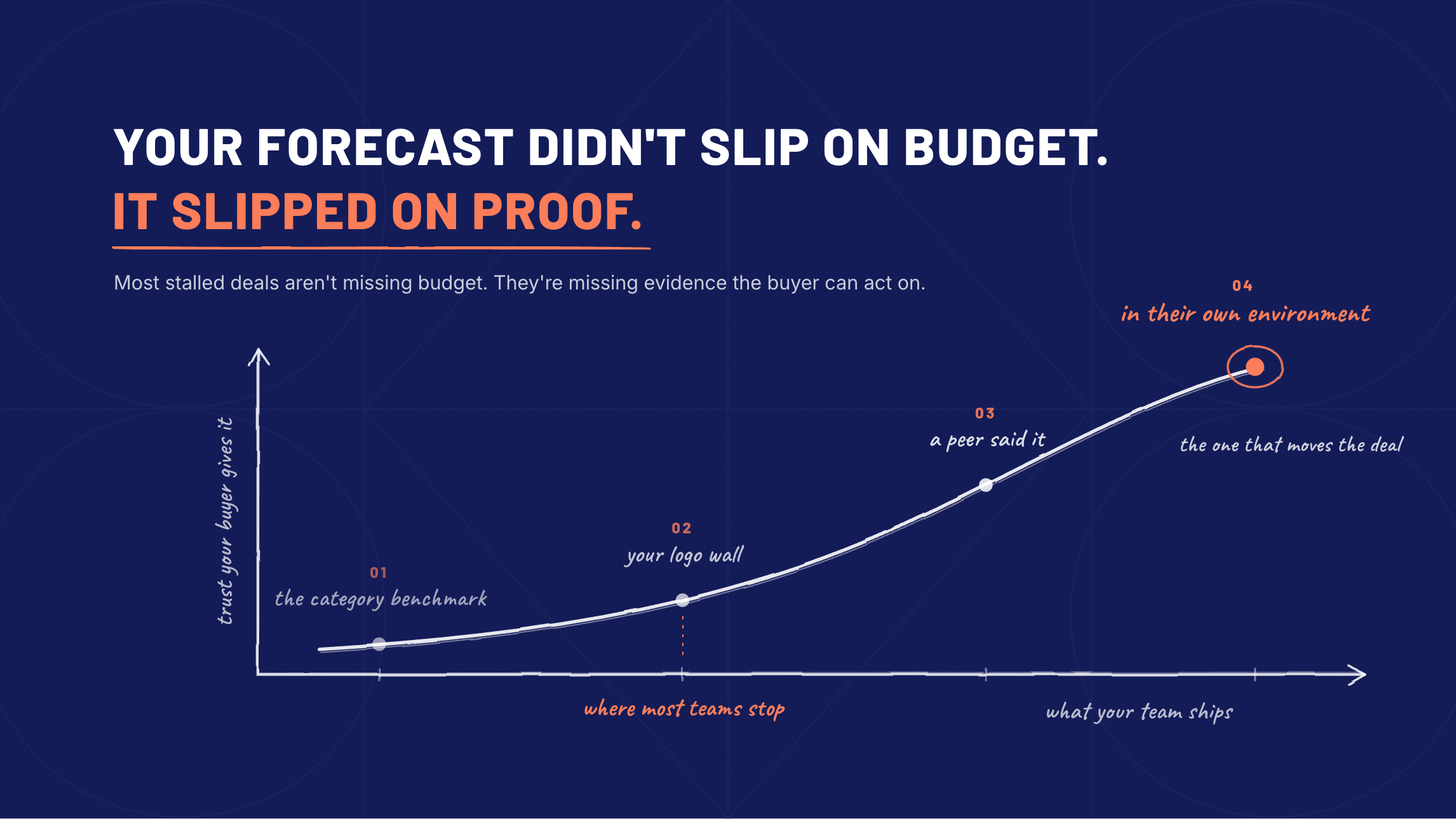
Proof, when you are selling your software, is not a monolith. There are four levels. Your buyer grades your team on which one you can actually offer for them, specifically. Most GTM teams ship whichever piece of proof lives closest to the top of the collateral folder. That is almost always the weakest one, because ease and strength run in opposite directions. The proof that is easiest for your team to attach is the proof that required no knowledge of this specific buyer to produce, and buyers can tell in one read. The four levels below are ranked by how much trust each one actually earns.
"The average B2B SaaS company grows MQLs by X percent." "Retention in vertical Y is Z percent." You can pull it from a Gartner report in thirty seconds. So can your buyer. They have already read the same report. It signals nothing about your product or their outcome. At the point of decision, table stakes are worth zero.
A named case study. One metric. One quarter. On one recognizable brand. It shows your team has done the work before. What it does not show is whether the work you did before is the work this specific buyer needs, at this stage, in this vertical. Case studies compress a nine-month engagement into three sentences and lose most of what mattered. Buyers know that. They read the study and mentally deduct 40 percent for the compression tax. Then they file it. Most GTM teams stop at Level 2 because it is easy to produce and it looks like credibility. It is credibility in the abstract. It is not credibility in the specific.
A named customer at your prospect's size, in your prospect's vertical, using your prospect's vocabulary. Not just a case study. A case study where the reader can see themselves. This is the level where trust stops being something your team asserts and starts being something a third party vouches for, and that changes the math. When your buyer recognizes themselves in the peer, they stop auditing your claims line by line and start borrowing the peer's judgment instead. And because the story is about someone like them, it travels without you. Your champion repeats it to their CFO with no deck in the room, and every retelling arrives carrying the peer's credibility instead of your sales team's. The engine of all this is not the metric. It is the language. If the peer's pain quote uses the same three words your buyer said on the discovery call, the buyer stops discounting and starts leaning in.
A number pulled from your prospect's own data. A dashboard they can validate against their own reality in ten seconds. A screenshot of their own instance running your product. This is the highest form of proof because there is no compression tax and no imagination required. It is theirs.
Most GTM teams cannot ship Level 4 because they never earned the access to build it. That is where the discipline lives, and where the highest-performing SaaS operators separate from the rest.
So here is the exercise I would run this week. Pull the last five first-touch emails your reps sent to serious prospects and look at what was attached. Not what the enablement folder says they should send. What they actually sent. Whatever level that material lives at is your real proof strategy, no matter what the deck in the board meeting claims. The answer sorts you into one of four situations.
If the answer is Level 1, that is a discovery gap, not a proof gap. Your team does not need a better case study. It needs a better first call, one that earns your team enough access to the buyer's data to offer Level 4 proof by the second meeting. Fix the discovery motion, and the proof problem solves itself.
If the answer is Level 2, your team has earned trust in the abstract but not in the specific. The work is to go back to the discovery notes, find how your buyer described their pain in their own words, and rebuild the case study around that description instead of around the metric. Buyers do not buy numbers on someone else's slide. They buy the recognition that another operator lived through the exact problem keeping them up right now.
If the answer is Level 3, your team is already better than most, and now you have a scaling problem. Level 3 proof requires knowing your buyers well enough to match them to the right peer story. That takes CRM hygiene, tagged case studies, and the discipline to write down every buyer's pain in their own vocabulary. If your case studies are not tagged by vertical and stage, your team cannot serve them by vertical and stage.
If the answer is Level 4, your team is running the play the way it is meant to run. What you have to guard against is Level 4 proof that looks like a stunt. Buyers can smell a metric that was mined for a sales moment. The way you keep Level 4 clean is by running your reporting cadence for the buyer's benefit, not the seller's. A weekly ROI report earns trust because it was already going to be sent, not because it was engineered for the close.
One more note on Level 4 that took most of the companies I work with longer to internalize than they would like to admit. When your team has Level 4 proof for one prospect, you have Level 3 proof for the next prospect in the same segment. Proof compounds one tier down the stack. Every buyer who lets you into their instance becomes the peer voice for the next three buyers who look like them. This is why your first customer in a wedge is worth more than the price they paid.
Buyers grade proof against themselves. Ship the piece that shortens the distance between what they are reading and their own dashboard. Everything above that is decoration your team pays for, and your buyer ignores.
Go back to the buyer at the top of this piece, the one who could not commit until he had a chance to actually physically get into it. He was not being difficult. He was telling the seller exactly where on the stack the deal would be won. That is what every level of the stack really is, the same request at a different volume. The benchmark asks you to trust the category. The logo wall asks you to trust our past. The peer asks you to trust someone like you. The instance asks you to trust your own eyes. The work is hearing which of those your buyer is asking for, and shipping that one.

Discover a full-proof SaaS lead scoring system for your B2B SaaS company to leverage as part of your ABM strategy.
Fix your landing page before your ad budget. This landing page conversion rate checklist covers clarity, speed, proof, and objection handling.

Salesforce's best trading day ever wasn't proof AI spared SaaS. It's a test for what's core vs. replaceable in your own marketing stack. Suggested...