Strategy & Planning
Why SaaS Companies Stall at $20M (And It's Not the Market)
If your SaaS company has stalled around $20M ARR, more pipeline probably won't fix it. Here's what's actually causing the plateau — and what...


Stijn Hendrikse
Jason Lemkin stirred the pot this week with a simple bar: to raise venture capital
today, you need a credible path from $1M to $100M ARR in five years or less. The
comment section debated the slope. I think the more interesting change is hiding on a
different slide entirely.
For fifteen years, the Use of Funds slide was the most boring slide in every B2B SaaS
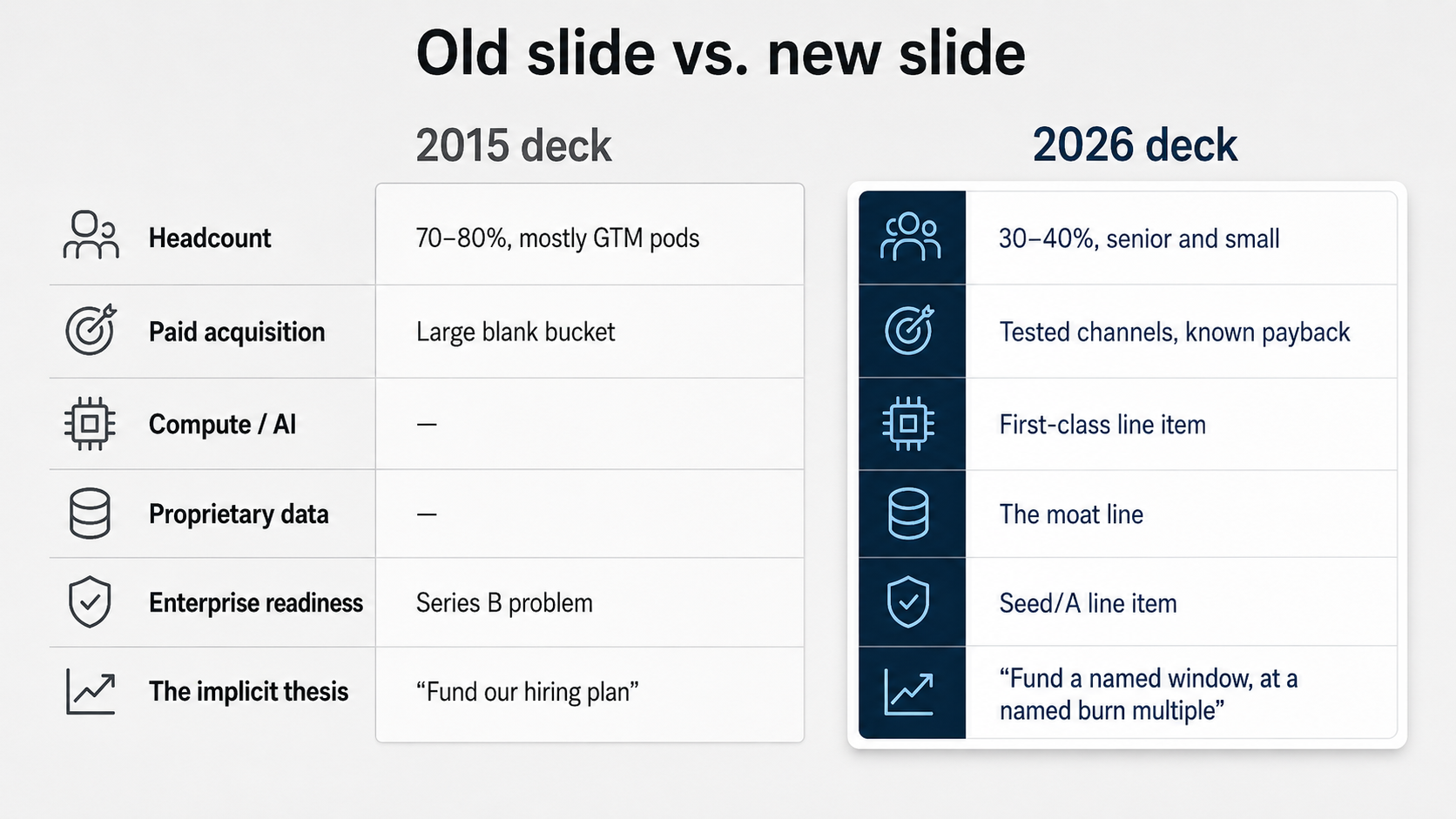
deck. Everyone knew what it said before the founder clicked to it: roughly 70–80% to
headcount — AE pods, SDR layers, a marketing team, customer success — plus a paid
acquisition budget to feed them, plus some runway math. Investors weren't really
underwriting a product. They were underwriting a hiring plan.
That slide is now a liability. Not because the categories became wrong all at once,
but because investors have started reading Use of Funds as a diagnostic: it's the slide that tells them whether you actually run an AI-native company, or just sell to one.
Two numbers moved from the appendix to the headline: burn multiple and revenue
per employee**.
When the work of an SDR pod, a content team, and half of marketing ops can be done by
well-built AI systems and a small senior team, a plan that says "we'll be 60 people by
Q4" no longer signals ambition. It signals that your own operations don't use the
technology you're presumably building with. The same investors demanding Lemkin's
100x now expect it at a fraction of the old headcount. The filter isn't growth
anymore — it's growth per dollar.
The uncomfortable implication for founders: your Use of Funds slide can disqualify
you even when your traction slide is great.
Here's what I see in the decks that get funded now — six line items, most of which
didn't exist as categories in 2015.
Compute and model spend, as a first-class line: Inference, fine-tuning, evals, data pipelines. This is the new COGS-adjacent growth spend, and sophisticated investors ask about it the way they used to ask about CAC. If AI spend is buried inside "engineering," they'll assume you haven't measured it.
A small, senior, expensive team — not a big one: The credible slide says "12 people at $10M ARR," not "headcount ramp." Every hire on the plan should be someone who *directs* leverage — a founder-level operator, a senior engineer, a real marketing leader — not someone who *is* the leverage. Junior layers whose job an agent can do read as a red flag.
Proprietary data and signal acquisition: Money spent making your AI defensible: datasets, integrations, expert annotation, the ground truth your models are grounded in. This is the moat line. It barely existed as a category before, and its presence tells an investor you understand where AI-native defensibility actually comes from.
Distribution experiments - not paid noise: The old slide had a blank "demand generation" bucket. The new one names channels with hypotheses: answer-engine optimization (being the answer ChatGPT and Claude give when your buyer asks), community, ecosystem and integration listings, founder-led content. Paid ads can appear — but as a tested channel with known payback, never as "brand awareness."
Enterprise readiness: SOC 2, security posture, procurement machinery. AI-native products hit enterprise scrutiny far earlier than classic SaaS did, because buyers now interrogate what your product does with their data on the first call, not at the 100-seat deal.
Speed — the honest line: The one legitimate descendant of blitzscaling logic: "we are raising to win the category window." AI-native categories close fast; capital buys the 18 months of compounding before a fast follower arrives. If this is your real reason to raise, say it — investors respect it far more than a padded operating budget.
Here's the reframe I'd push every founder to sit with before building the slide.
T2D3 — triple, triple, double, double, double — was never a financing strategy. It's what happens after product-market fit, once you've proven enough customers both pay and stay, when you compound every growth lever at once: diversifying demand generation beyond the channel that got you to $1M, raising conversion rates while shortening the funnel, expanding ARPU — all without letting churn creep up.
Capital is fuel for a specific lever, if the formula needs it. It is not the strategy itself.
So the modern Use of Funds slide, done honestly, is a lever map: this dollar goes to this growth lever, with this expected payback. If you can't write that sentence for a line item, delete the line item. And if you can't write it for the round — if the honest answer is "we'd hire a big team and make noise" — the most credible slide might be the one that says you're not raising at all. Plenty of companies can now fund compute and distribution from revenue, and investors know it. "Default alive, raising only to win the window" is a position of strength; a headcount-heavy raise is increasingly read as its opposite.
The Use of Funds slide used to be where diligence went to nap. Today it's where investors find out, in about eight seconds, whether you're building a 2026 company or a 2015 company with a newer pitch template.
Build the slide like your operations depend on it — because that's exactly how it will be read.

If your SaaS company has stalled around $20M ARR, more pipeline probably won't fix it. Here's what's actually causing the plateau — and what...
B2B SaaS deals stall on proof, not budget. The four levels of evidence buyers trust, and how to fix your proof gap.

Here are some basic rules for when you consider discounting your SaaS products or services. When you discount your SaaS Pricing, what did you get in...