GTM
The Five Tests Every B2B SaaS ICP Must Pass
Five tests separate a real ICP from a market segment with a title slide. Most SaaS teams fail at least one. Find out which ones.


Braison Murgai
Ask a founder who their ideal customer is and listen for the first two words. More often than not, they're "anyone who."
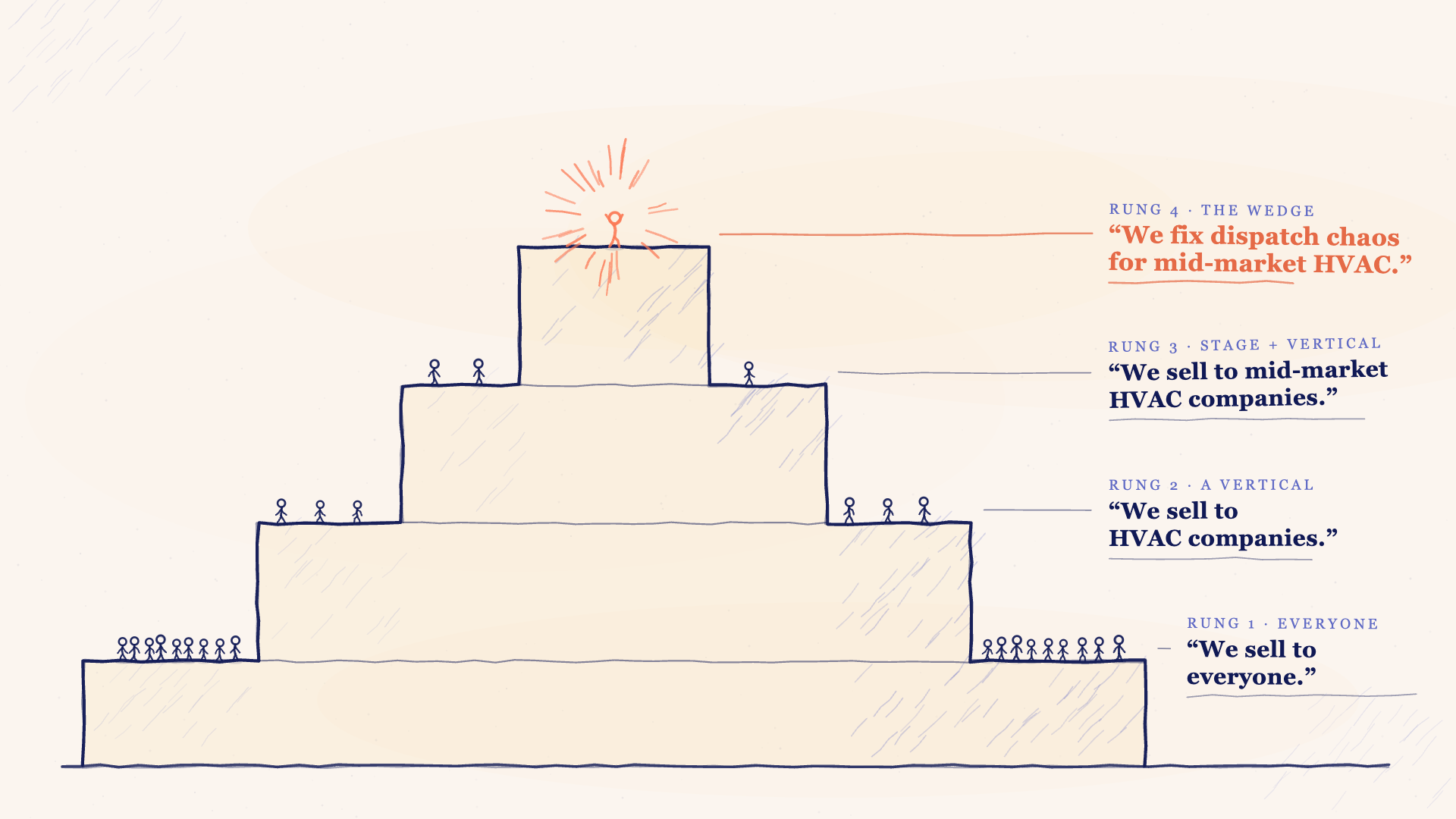
I posted a four-rung framework about this earlier in the week: the ICP Narrowing Ladder. But a post can name a ladder. It can't teach the climb. So this is the full walkthrough. By the end you should be able to write your ICP on one line, know which rung you're standing on, and know the exact exercise that gets you to the next one.
Let's go.
Monday morning I sent 15 outbound emails. Same opener on every single one. "The real bottleneck is positioning, not leads. Wrong audience, wrong message, wrong timing."
I wrote that line because I keep watching it play out. On discovery calls where the founder can't finish the sentence "our buyer is." In pipelines where deals stall at 10 percent because nobody's urgency ever got named. In my own book, where the conversations that go somewhere are the ones where I can describe the prospect's problem better than they can.
The pattern reduces to one variable: precision. How precisely you define your ideal customer determines what you can charge, who you can hire, and whether your outbound gets read or deleted. Everything else is downstream. So I drew it as a ladder. Four rungs, each one a level of precision.
One thing before we climb. This is not a marketing exercise. It looks like one, which is exactly why it gets handed to marketing and then quietly dies there. It's a founder decision wearing a marketing costume. Keep that in mind the whole way up.
What it sounds like: "We help businesses run more efficiently."
Say it out loud. Now picture your buyer reading it in a cold email at 7am, sandwiched between a staffing problem and an angry customer. Does anything in that sentence make them feel seen? Anything?
That's the problem. A category is not an ICP. When your ICP is a category, your message has to stretch far enough to cover a two-truck HVAC shop and a national mechanical contractor at the same time. Any sentence that fits both describes neither.
Rung 1 outbound is spam with a signature. No judgment, I've written plenty of it. It doesn't work.
The test: if your ICP sentence could sit on a competitor's website and nobody would notice, you're on Rung 1.
What it sounds like: "We sell to HVAC companies."
Feels like progress. And it is. Barely. Check yourself against what you still can't do from here.
You can't price. An HVAC shop with three trucks and one with three hundred need completely different things from you, so which one is the offer for? You can't pick channels. Those two companies trust different rooms, read different trade publications, sit in different owner groups. And you can't write one message that lands with both, because their painpoint positions are miles apart. One is fighting to keep the phones answered. The other is fighting to keep forty dispatchers coordinated.
Most companies that believe they've "picked a niche" are standing right here. A vertical is a direction, not a destination.
The test: name the top three channels where your buyer already spends trust. If you hesitated, you're on Rung 2. You can't run a watering hole analysis on a vertical. A vertical is too wide to have a watering hole.
What it sounds like: "We sell to multi-location HVAC companies running 10 to 50 trucks."
Stage just means how far along the company is. For your buyer that might be truck count, locations, headcount, or revenue. Pick the measure their world actually uses.
Now the work starts paying. You can price, because companies at that size have real software budgets, and those budgets cluster. You can hire, because the skills that serve them have names. And you can finally run that watering hole analysis and list the actual trade groups, podcasts, and newsletters where this buyer already spends trust.
So here's the uncomfortable part. Rung 3 is where most founders stop. It's also where most agencies are happy to stop billing against, because Rung 3 is defensible in a slide deck. It sounds narrow. It photographs well in a pitch.
But watch what happens when your Rung 3 email lands. "We help multi-location HVAC companies grow." So do forty other vendors who bought the same list. You've earned the right to be considered. You haven't earned the reply.
The test: your outbound gets polite responses. "Looks interesting, circle back next quarter." Polite is the tell. Polite means relevant but not urgent. That's Rung 3.
What it sounds like: "We sell to multi-location HVAC companies losing service revenue because dispatch still runs on whiteboards and group texts."
Read that again and notice what happens. The owner drowning in those group texts doesn't evaluate that sentence. They recognize themselves in it. That takes about three seconds, and that three-second self-recognition is the entire game in outbound. It's the difference between "this is for people like me" and the delete key.
Every word in a Rung 4 sentence earns its keep. The stage sets the budget. The vertical sets the language. The pain sets the urgency. Pull any one of them out and the whole sentence goes soft.
Want another so you can feel the pattern? "We sell to commercial HVAC contractors whose techs lose two hours a night retyping job data into three different systems." Same industry, different segment, different pain, same mechanics. A buyer in that ICP knows within one breath whether this is about them.
That's your sweet spot.
Every time I walk a founder through this, the same objection shows up at Rung 4. Might as well say it out loud.
"Doesn't narrowing this far shrink my market?"
Wrong fear. The sweet spot isn't the ceiling of your ambition. It's your way in. You win that narrow slice first, stack referrals and proof inside it, and then you move into the adjacent stage or vertical carrying a reputation instead of a cold list.
And this isn't my idea, to be clear. It's the entire logic of the T2D3 growth model Stijn Hendrikse wrote down after living it at Microsoft and Acumatica. The companies that ran from one million to a hundred million in ARR didn't start broad. They started narrow and earned the right to widen. The first chapter of that playbook isn't about demand gen. It's about nailing a niche. There's a reason it goes first.
Stuck on Rung 3? Here's the exercise. One afternoon, no tools, no budget.
Pull your last ten closed-won deals. For each one, write down the sentence the buyer said on the first call that made the deal real. Not the feature they asked about. The pain they admitted. The moment the call stopped being a demo and started being a confession.
In my experience the same admission shows up in six or seven of the ten. That admission, in the buyer's own words, is your fourth rung.
Don't have ten closed-won deals yet? Run the same play on your discovery calls. Count which pain made prospects lean in versus nod politely. Leaning in is data. Polite nodding is also data.
Then run the three-second test. Write your ICP on one line, stage plus vertical plus pain, and show it to someone who actually fits it. If they don't say some version of "that's exactly us" within three seconds, the pain is either wrong or written in your language instead of theirs. Rewrite it with their words. Your buyer's vocabulary is a positioning asset most companies never bother to collect.
When you write your ICP down and it reads "we help B2B companies grow," the temptation is to treat it as a copywriting problem. Hire someone to punch it up. Make it prettier.
It's not a copywriting problem. It's a decision you've been dodging.
Narrowing means saying no to revenue that looks real. It means telling a prospect who could pay you today that they're not who you serve. I won't pretend that's easy. I catch myself drifting back up the ladder every time a juicy off-profile deal shows up in my pipeline, and man, I run this framework for a living. The ladder isn't something you climb once. You re-climb it every quarter, because drift is the default.
That's why it can't be delegated. Marketing can sharpen the words. Only the founder can pick the customer.
Keep these and you keep the article.
A category is not an ICP. If your sentence fits a competitor's website, it isn't yours.
Rung 4 is stage plus vertical plus pain, and the pain has to be in the buyer's own words, not yours.
Polite responses are a diagnosis. Relevant but not urgent means you're one rung short.
And the exercise: ten closed-won deals, the sentence that made each one real, find the admission that repeats. That's your sweet spot.
Write your ICP on one line. Read it back slowly. Which rung are you on?
And the harder question, the one I actually want answers to in the comments: what would Rung 4 cost you to claim?
Name the revenue you'd have to say no to. That number is where the real conversions start.

Five tests separate a real ICP from a market segment with a title slide. Most SaaS teams fail at least one. Find out which ones.
Most B2B SaaS ICP docs collapse acquisition and expansion into a single profile. Here is how to bifurcate your ICP correctly and why it changes...
Sequencing beats tactics. Building an audience before the product forces the ICP discipline that founders usually find only after their first launch...