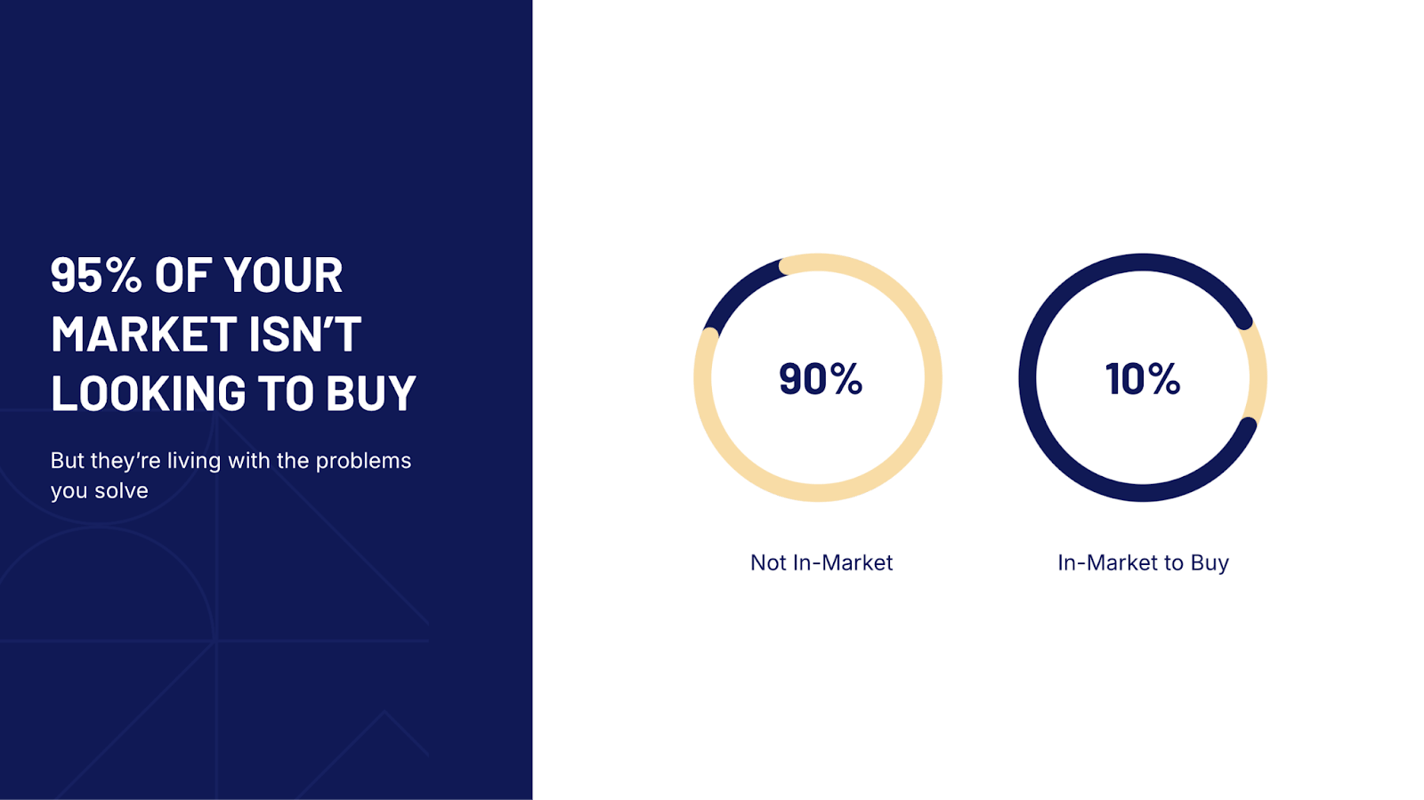
At any given moment, only 5-10% of your TAM is actively looking for a solution like yours, meaning they are not casually exploring but intentionally researching vendors, comparing options, and preparing to make a decision.
That leaves roughly 90% of your potential buyers who are not searching for your category, not evaluating tools, and not thinking about booking a demo today.
Still, most B2B SaaS marketing budgets are overwhelmingly designed to capture that small in-market segment, concentrating spend on high-intent search terms, vendor comparison content, and aggressive demo calls-to-action because it makes sense: if someone is already shopping, you want to be visible.
But here is the structural issue: if your entire strategy revolves around competing for the small percentage of buyers who are already in buying mode, then your growth ceiling is constrained by the size of that in-market pool.
The 10% Trap
In the early stages of a category, focusing on the 10% who are already looking can feel like a winning strategy because competition is thinner, acquisition costs are still reasonable, and it is entirely possible to win meaningful share simply by showing up consistently and executing well.
For a while, that works, but eventually the category matures.
More vendors enter the space and start bidding on the same keywords, messaging begins to sound interchangeable because everyone is optimizing around the same search intent, and customer acquisition costs gradually rise as differentiation narrows and competition intensifies.
So you respond the only way that seems logical. You optimize the funnel, test new copy, increase budget to maintain volume, squeeze efficiency out of every channel you can measure…
And yet pipeline stays roughly the same. The problem is that you are applying more pressure to the same small slice of demand and expecting a different outcome.
What Happens to the Other 90%?
The other 90% of your market is not irrational, uneducated, or incapable of understanding your value. They simply have not prioritized the problem yet, don’t feel a pressing sense of urgency, are tolerating inefficiencies because the pain has not crossed a threshold, or have not fully connected the long-term cost of inaction to their current situation.
In other words, they are future buyers.
But because they are not actively searching, most SaaS companies behave as if they do not exist, directing almost all energy toward the minority that is already in evaluation mode.
This is where demand creation lives, not in vague brand awareness campaigns, but in the deliberate effort to help that 90% see, frame, and quantify a problem before they ever type a query into Google.
Demand Capture vs. Demand Creation
Demand capture begins once the buyer has already decided that a problem exists and that it deserves budget, attention, and a shortlist of vendors to evaluate. At that point the conversation is competitive by default, because you are stepping into a decision process that is already underway.
Demand creation operates earlier, before the category is even on the table, by influencing how buyers understand their situation, how they frame the problem internally, and whether they assign urgency to solving it at all.
When you focus on capture, your message is essentially an argument about superiority, positioning your company as the best option among available alternatives in a market the buyer already recognizes.
When you focus on creation, your message is about reframing, helping the buyer see a risk they have normalized, a cost they have underestimated, or an opportunity they have not yet quantified.
If you only capture, you harvest what already exists, but if you create, you expand the pool of people who will eventually enter the market.
And this is the nuance many SaaS teams miss: demand creation does not replace demand capture, nor should it, because showing up when buyers are ready is still essential. What demand creation does is stabilize and strengthen capture over time, because when you shape how your market thinks before evaluation begins, more buyers eventually enter that ten percent already familiar with your perspective and predisposed to trust your approach.
Why Most SaaS Teams Avoid the 90%
If the opportunity in the 90% is so large, why do most SaaS companies ignore it?
There are usually three structural reasons, and none of them are about ignorance. They are about incentives.
Attribution
The 10% is easy to measure because it shows up cleanly in dashboards through clicks, form fills, demo requests, and pipeline that can be traced back to a campaign with reasonable confidence. The 90% does not behave that way, because influencing how someone thinks months before they enter a buying cycle rarely fits neatly into last-click reporting.
If your performance model rewards what can be directly attributed to a demo form, then you will naturally concentrate investment on channels that produce immediate, trackable intent. Over time, this creates a bias toward capture because capture is visible and creation is diffuse.
Sales Pressure
Sales teams are accountable to quota, and quota favors leads that are already in evaluation mode. When that pressure flows upstream, marketing is incentivized to prioritize urgency signals over educational influence, which means optimizing for prospects who are already searching rather than investing in shaping how the broader market thinks.
Urgency feels productive. Education feels indirect.
But urgency is limited by how many buyers are already motivated, while education scales across an entire segment that has not yet decided to act.
Short-Term Thinking
Demand capture can produce pipeline within weeks, sometimes even days, which makes it attractive in board meetings and quarterly reviews. Demand creation compounds more slowly because it operates earlier in the buyer journey, and its impact is often visible over multiple quarters rather than within a single reporting cycle.
Most teams optimize for this quarter because that is how they are evaluated.
Category leaders optimize for the next two years because they understand that shaping how a market thinks is what ultimately determines how much of it will be in-market later.
How to Activate the 90% Without Burning Budget
Reaching the 90% is not about launching vague brand campaigns or increasing content volume in the hope that something sticks. It is structured work that starts with understanding your buyers at a level most companies never reach.
Begin with deep customer interviews, not surface-level testimonials, but real conversations that explore what was happening before they bought, what risks they were tolerating, what workarounds they had normalized, and what finally pushed the issue high enough on their priority list to take action.
Inside those conversations are the signals you need.
From there, the job is to turn those raw insights into simple frameworks that allow your ideal customer to self-diagnose, because when someone can see themselves clearly inside a problem, urgency becomes internal rather than imposed by marketing copy.
This requires focus.
If you try to activate five different segments at once, your message becomes diluted and your authority becomes thin. Authority requires density, which means committing to one ICP at a time and building a body of thinking that consistently speaks to their world in language that feels specific and grounded.
Distribution matters too, but it should follow logic rather than habit. Instead of trying to be visible everywhere, concentrate on the places where your strongest customers already pay attention, whether that is a niche community, a specific publication, or a tightly defined social network.
And sequence matters more than scale.
Extract the signal first, which means clarifying positioning, sharpening personas, and articulating the real problem in your customers’ own words before you amplify anything with AI tools or paid distribution. When you amplify weak signal, you simply scale noise.
The goal is not traffic but problem recognition.
As more of that 90% begins to see and articulate the problem you help define, a larger portion of the market moves into active consideration. That is how you expand the in-market segment over time instead of exhausting yourself competing over the same small pool of ready buyers.
The Compounding Effect
When you consistently engage the 90% instead of ignoring them, you begin to see subtle but powerful shifts in how your growth engine behaves.
Branded search volume starts to rise because buyers are no longer encountering your company for the first time during vendor comparison; they are actively looking for you by name.
Sales conversations feel different because prospects arrive with context, familiarity, and a clearer understanding of the problem you solve, which reduces the time spent explaining fundamentals and increases the time spent aligning on fit.
Price pressure eases because your value has already been framed in the buyer’s mind before procurement steps in, and customer acquisition costs stop climbing at the same pace because you are no longer relying exclusively on competitive auctions for attention.
Even outbound performs better when the market has been primed, because the message lands in a mind that has already been exposed to your thinking.
Buyers do not suddenly discover you at the moment of evaluation, they have been absorbing your perspective long before they ever request a demo.
That is what changes the economics of growth, because you are no longer dependent on intercepting intent at the last possible moment. You are influencing it upstream.
The Strategic Question
Now step back and look at your current budget allocation with honesty.
How much of your spend is concentrated on competing for the 10% that is already in buying mode, and how much is invested in shaping how the other 90% understands the problem in the first place?
If the overwhelming majority of your budget is aimed at in-market buyers, then your growth ceiling is structurally constrained, not because your team lacks effort or competence, but because you are competing for attention inside a fixed pool instead of expanding the pool itself.
Only a small fraction of your market is ready to buy today.
The SaaS companies that grow the fastest deliberately influence the larger segment of future buyers so that, over time, more of them enter the market already aligned with their point of view.
Webinar: The 3 Pillars of Qualified Pipeline Generation in B2B SaaS
If your pipeline depends primarily on competing for existing search intent, and customer acquisition costs continue to rise, watch the full masterclass where Kalungi Co-founder Stijn Hendrikse explores the shift from demand capture to demand creation.
The session examines how to engage the portion of your market that is not yet searching, how to measure the impact of authority-building initiatives, and how to align sales and marketing around a longer-term growth engine.
Watch the recording here

Ready to Build a Growth Engine That Holds?
If you want clarity on whether your current strategy is over-indexed on capture and under-invested in creation, apply for a T2D3 Growth Workshop.
In this focused session, we will review your channel mix, analyze your attribution signals, and identify where authority-building efforts can unlock incremental, sustainable growth.
Apply for Your T2D3 Growth Workshop here