Strategy & Planning
The cost of outsourcing your B2B SaaS marketing to an agency
Whether B2B SaaS companies don’t have the time to build their first in-house team or don’t want to invest in another marketing agency selling empty...


Cris S. Cubero
Inconsistent pipeline performance in growth-stage B2B SaaS companies is often blamed on execution. Teams assume they are not running enough campaigns, not hiring quickly enough, or not pushing hard enough on sales. In many cases, however, the root cause is focus.
Companies between $1M and $10M in ARR frequently try to expand across multiple markets at the same time. They may pursue healthcare, fintech, mid-market, enterprise, and SMB segments simultaneously. From a distance, this approach looks balanced because it suggests diversification rather than dependency on a single segment.
But in practice, spreading budget, messaging, and product attention across several ideal customer profiles reduces clarity in each one. Positioning becomes broader in order to accommodate multiple audiences, and as relevance declines within each segment, pipeline performance becomes less consistent. This parallelism causes reduced traction.
Consider a typical growth-stage SaaS company operating with a $60K monthly marketing budget, two SDRs, one content marketer, and a founder who functions as the primary subject matter expert.
If that company chooses to pursue three ICPs simultaneously, it is not running one growth strategy, it is basically running three partial ones.
Each segment receives limited attention, messaging is adapted but not deeply developed, case studies are created, but there are too few in each vertical to establish strong credibility. In the end, content clusters remain incomplete because resources are divided, and sales narratives shift depending on the industry, which prevents refinement and consistency.
Authority does not accumulate in any one market, and no segment reaches the level of visibility required to generate sustained momentum.
The operational effects follow naturally. Sales teams begin requesting additional vertical-specific materials to address recurring objections, marketing responds by broadening positioning to accommodate multiple audiences, and product priorities become more complex as different industries request different features, leading to a fragmented roadmap.
Over time, pipeline conversion rates decline. The organization is active, but traction weakens.
This dynamic is often described as diversification. In reality, it creates strategic debt that slows growth rather than supporting it.
Before launching additional campaigns or expanding into new markets, ICPs should be evaluated and ranked using clear, measurable criteria rather than intuition.
Two variables tend to provide the most clarity.
The first question is straightforward: where does your company already have meaningful traction?
Include the number of customers within each segment, the amount of ARR generated from that segment, win rates, and the average sales cycle length. These indicators reveal whether traction is incidental or repeatable.
One practical way to compare segments is to calculate the ratio of ARR within a given segment to the total addressable ARR available in that segment. This penetration ratio offers a relative measure of strength. A smaller market with concentrated traction may represent a stronger position than a larger market with scattered wins.
The second variable concerns operational efficiency: in which segment are deals simply easier to win and manage?
Include implementation time, discount pressure, ongoing support burden, the frequency of custom feature requests, and customer acquisition cost by segment. Some markets generate revenue but require disproportionate effort to maintain.
When each ICP is plotted on a simple 2x2 matrix—penetration on the X-axis and ease of expansion on the Y-axis—one segment typically stands out. The segment in the top-right quadrant combines existing traction with operational efficiency.
That segment should become the execution priority for the next 90 days. Not the company’s permanent focus, but its immediate one.
Focusing on a single ICP does more than simplify strategy. It improves the structure of the entire funnel. When attention is concentrated, performance metrics tend to strengthen in measurable ways.
When messaging is written for one specific persona within one defined industry, it becomes clearer and more relevant. Prospects recognize their own environment, constraints, and goals in the narrative. As a result, demo-to-close rates improve because conversations begin from shared context rather than broad assumptions.
Objection handling also becomes more consistent: patterns repeat, responses refine, and case studies no longer describe general outcomes; they demonstrate results within the same operating environment as the prospect.
Specific positioning increases conversion efficiency because relevance reduces hesitation.
Within a defined niche, credibility compounds. When multiple companies in the same vertical adopt a solution, subsequent prospects perceive lower risk, references are directly comparable, and success stories feel applicable rather than aspirational.
Over time, sales narratives become standardized. The team learns which proof points resonate and which concerns recur. This consistency shortens sales cycles because less time is spent establishing legitimacy.
Velocity improves when buyers feel they are following a proven path rather than taking a leap.
Running campaigns across several ICPs requires separate creative strategies, landing pages, and value propositions. Each segment demands its own testing cycle. This fragmentation increases the cost per qualified opportunity.
When focus narrows, messaging aligns across channels. Content relevance improves, CTRs and conversion rates rise because the audience is clearly defined, and with cleaner data and more consistent performance, acquisition costs tend to stabilize or decline.
These outcomes are not the result of brand perception alone. They are structural effects of concentration.
In SaaS companies below $10M ARR, founders and senior product leaders often carry the company’s strongest market insight. They understand the original problem, the customer context, and the trade-offs behind the product decisions. In many cases, this expertise is the primary source of differentiation.
The constraint is time.
When that limited time is spread across several ICPs, the output becomes generalized. Messaging attempts to address multiple industries at once and insights remain surface-level because they must apply broadly. Positioning ends up losing clarity because it is designed to accommodate several narratives rather than define one.
Concentrating founder attention on a single ICP allows for industry-specific challenges to be explored in depth. Clear opinions can be formed and messaging becomes sharper because it reflects real understanding rather than abstraction.
When limited expertise is directed toward a defined audience, signal strengthens when attention is focused rather than divided.
Instead of extending internal debates about which market to prioritize, companies can apply sequencing through structured 30-day execution cycles. The purpose of a sprint is not to guarantee revenue within a month but to test relevance under concentrated effort.
For a defined 30-day period, the organization aligns around one ICP. This means
At the end of the sprint, performance should be evaluated using leading indicators rather than closed deals. Useful measures include the percentage of target accounts engaging, demo-to-opportunity conversion rates, the quality and depth of sales conversations, recurring objection themes, and early signs of pipeline velocity.
If engagement remains weak after concentrated focus, the constraint is unlikely to be sales cycle length. It is more likely an issue of relevance. The organization can then pivot to the next ranked ICP based on data rather than assumption.
Three disciplined sprints typically produce clearer strategic direction than several months of diluted execution across multiple markets.
A longer sales cycle does not eliminate the value of a 30-day evaluation window. Companies with six-month deal timelines often assume that results cannot be measured within a month. In practice, early signals appear well before contracts are signed.
During an ICP sprint, revenue is not the primary metric, engagement quality is your goal. The objective is to determine whether the selected segment responds meaningfully to concentrated attention.
Useful indicators include clearer acknowledgment of the problem being solved, improved progression from first meeting to next steps, stronger alignment between buyer needs and product positioning, and fewer repetitive objections rooted in misunderstanding. These signals suggest that relevance is increasing and that continued investment is justified.
If focused effort fails to generate stronger conversations or measurable engagement, additional time alone is unlikely to change the outcome. Extended duration cannot compensate for weak market fit.
When a company pursues several ICPs at once, execution fuzz appears (activity increases, but clarity declines).
The first sign is sales friction. Sales teams begin requesting additional vertical-specific decks, case studies, and landing pages. These requests are not the root problem; they are a response to positioning that lacks depth. When messaging is not firmly anchored in one industry context, sales compensates by asking for more materials to bridge the gap.
The second sign is weak branded search and unclear market association. If prospects do not strongly associate the company with one specific problem or industry, recall suffers. The brand becomes familiar but not defined. And without a clear anchor, memorability declines and inbound momentum weakens.
Market dominance requires concentration. The most reliable path to growth is depth within a single, well-chosen segment.
Prioritizing one ICP does not mean closing the door on all others. The distinction lies in how resources are allocated.
Secondary segments can remain active through automated nurture programs and inbound inquiries from those industries can still be addressed. Existing customers in adjacent markets continue to be supported, what changes is where strategic attention is directed.
Founder time, senior sales focus, and product prioritization should align with the primary segment selected for concentrated growth. Automation maintains visibility across other markets without diverting manual effort. This approach preserves optionality while preventing fragmentation.
Predictable pipeline performance depends on structural consistency.
It requires a clearly defined ICP, repeated and coherent messaging, social proof that compounds within a defined community, and a concentrated signal in the market. These elements reinforce one another over time.
When multiple ICPs are pursued simultaneously, proof points become scattered: messaging shifts depending on the audience and funnel data reflects several narratives rather than one consistent story. This fragmentation makes it difficult to identify what is working and why.
Sequencing simplifies the system. With one defined segment, data becomes clearer and patterns emerge more quickly. Optimization becomes structured rather than reactive, and we know structured optimization leads to more predictable growth.
If your SaaS were required to reach $10M ARR by winning one segment first, which segment would offer the highest probability of dominance within the next twelve months?
The answer to that question should guide execution.
Not several segments.
One.
If your pipeline feels inconsistent despite steady activity, the underlying issue may be ICP focus rather than execution volume.
In this masterclass, Kalungi Co-founder Stijn Hendrikse explains how SaaS companies move from scattered traction to concentrated growth.
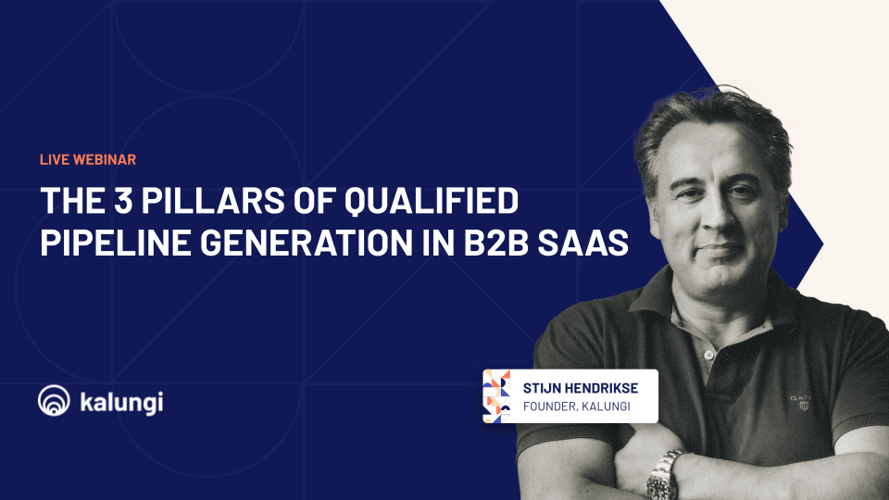
If you want clarity on whether your current growth strategy is concentrated or fragmented, apply for a T2D3 Growth Workshop.
In this session, we evaluate your ICP penetration, operational friction across segments, and current pipeline performance.

Whether B2B SaaS companies don’t have the time to build their first in-house team or don’t want to invest in another marketing agency selling empty...
Download our free marketing calendar template for your SaaS company. Start planning your B2B SaaS marketing strategy and align with your marketing...
Discover how B2B SaaS companies can reverse rising customer acquisition costs by adopting a more efficient, lifecycle-focused marketing strategy. ===...