Strategy & Planning
How We Hire at Kalungi: Building the First Syntropy Agency for the AI Era
At Kalungi, we hire for signal — not noise. Here’s how we find and grow humans who create syntropy in an AI-saturated world.


Cris S. Cubero
No matter the growth stage, category, or how strong the team behind the SaaS is on paper, when marketing stops working, it’s almost always because clarity disappeared somewhere along the way, and nobody noticed when execution started filling the gap.
Things still ship but the work starts feeling heavier than it should. Everyone senses there’s noise, but it’s hard to point to a single decision that caused it. What we’ve learned is that noise comes from ideas losing their place in the sequence. And execution has a way of amplifying whatever intent exists underneath it. When intent is clear, execution compounds signal, but when intent is fuzzy, execution just makes the fuzz louder.
Kalungi’s Wow – How – Now is a way to sanity-check our own thinking before we ship anything.
The first mistake we see is teams assuming buyers are ready earlier than they actually are.
We love to explain, show competence, and jump straight into the “how”, but most buyers are not sitting around waiting for a better explanation. They’re sitting in stasis, comfortable enough, busy, not convinced that changing anything is worth the effort.
When teams explain too early, nothing is technically wrong, it’s just misplaced. The message doesn’t land because the internal conditions for hearing it haven’t been met, and instead of recognizing that, teams often respond by explaining more clearly, more thoroughly, more often. That’s how noise accumulates.
Once you see this pattern, it becomes hard to unsee it.
Restoring signal requires order, not more activity. That order begins with understanding what must happen first.
We didn’t arrive at Wow – How – Now by trying to invent a new way to talk about messaging. We arrived at it by repeatedly asking ourselves why certain work moved buyers forward while other work, often just as well executed, quietly stalled. Over time, we noticed effective messaging respected sequence. It met buyers where they were, instead of where we wished they were, and it did one job at a time.
Wow – How – Now is simply a way of naming that sequence. Not to constrain creativity, but to impose just enough order before execution begins. Each stage reflects a different buyer state, and each answers a different question that must be resolved before the next one matters. When those questions are addressed in the right order, momentum builds naturally. If you mix them together, even strong ideas will struggle to land.
Reference: BSMS 93 - The "Why" vs the "Wow, How, Now" frameworks in your GTM
That’s where Wow comes in. And we don’t mean “wow” as in clever or impressive. We mean the moment where something shifts internally for the buyer. Where they realize, sometimes uncomfortably, that the status quo isn’t as safe or sufficient as it felt yesterday.
Wow is not education, it’s relevance. It answers a very specific question: why change at all?
If that question hasn’t been answered, everything else is noise. We’ve seen teams write beautiful content, technically flawless, deeply informed, and completely ignored because it assumed a problem the buyer hadn’t accepted yet. Without Wow, you’re talking to yourself, no matter how well you explain.
Once relevance exists, something changes. Now the buyer is listening. Not agreeing yet or buying, but they’re paying attention. And that’s where How starts to matter.
This is the part people misunderstand most. How is not tactics or features yet. It’s not “here’s how our product works.” It’s about credibility over time, about showing how you think, how you approach problems, and how consistently you show up once someone decides you’re worth listening to.
How is where trust accumulates slowly and quietly. It’s evergreen for a reason. It’s not trying to spike attention but trying to sustain it. And when How is done right, the buyer stops re-evaluating whether you’re legitimate and starts evaluating whether this change is worth pursuing with you.
Even after saying How, things may stall. This part is subtle and easy to miss. Buyers can care and trust you and still not move. And not because they’re unconvinced, but because timing is unclear. There’s no internal reason to act now instead of later, and later is always easier.
That’s where Now comes in. And not in the way people usually think about urgency. Now isn’t pressure, it’s clarity, it’s helping the buyer see what happens if they wait, what changes if they don’t, and why this moment is different from all the others they’ve postponed action.
When Now shows up too early, it feels pushy. When it shows up without trust, it feels risky. When it shows up after Wow and How, it feels almost obvious. Like the next step makes sense because the sequence earned it.
Pain, claim, gain is another way of describing the same movement. Pain is the Wow. Claim is the How. Gain is the Now. Different language, same progression.
Both frameworks name patterns that already exist in how buyers actually move. Once you see that, you stop arguing about terminology and start paying attention to order.
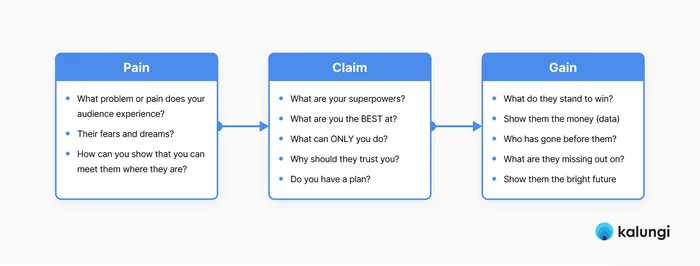
The real danger isn’t getting any one piece wrong in isolation but mixing them together. Asking for action while still trying to create relevance. Explaining capabilities before the buyer agrees there’s a problem. Treating every piece of content as if it’s doing the same job.
That’s how noise creeps in, quietly.
Turning attention into action isn’t about saying better things but the right thing, in the right order, for the right reason. Wow – How – Now is a way to keep yourself honest about sequence, especially when everything around you is pushing for more output.
At some point, we realized Wow – How – Now only works if it’s treated as a gate, not just a guideline. The mistake teams make is agreeing with the sequence conceptually, then ignoring it the moment execution pressure shows up.
In practice, this means refusing to ship work unless two questions can be answered clearly:
Before creating anything, we now require a clear answer to what this is for and who it’s for. If we can’t answer that, the work doesn’t ship. This way clarity becomes the price of admission.
From there, Wow – How – Now determines where the work belongs. Is this meant to move someone out of stasis? Build trust as they evaluate change? Or create a reason to act now? That decision shapes not just the message, but the channel, the timing, and how success is measured. Work that tries to do all three usually does none of them well.
This discipline changes how planning and prioritization work. Instead of asking what to produce next, the question becomes which buyer state is currently the bottleneck. Output follows that bottleneck. When relevance is missing, more explanation is waste. When trust is missing, more urgency backfires. When timing is unclear, more content doesn’t help.
Over time, this also changes what compounds. Work that is clearly sequenced gets reused, referenced, and built upon. Work that isn’t gets replaced. Teams either accumulate signal or continuously restart. There’s rarely a middle ground.
Treating Wow – How – Now as an operating constraint is what turns it from a mental model into a system. Without that constraint, it remains an interesting idea. With it, it shapes what gets planned, what gets funded, and what gets shipped.
At Kalungi, we hire for signal — not noise. Here’s how we find and grow humans who create syntropy in an AI-saturated world.
Discover how Kalungi's Syntropy service helps SaaS founders transform raw insights into scalable marketing momentum, bridging the gap between DIY...
Discover how Kalungi ensures measurable results for B2B SaaS marketing through accountability. Learn about our strategies & pay-for-performance model.