Marketing Leadership
The B2B SaaS CAC Reversal
Discover how B2B SaaS companies can reverse rising customer acquisition costs by adopting a more efficient, lifecycle-focused marketing strategy. ===...


Cris S. Cubero
AI conversations in revenue teams usually go this way: leaders agree that change is needed, experiments begin, tools get added, and then progress slows because no one has made an explicit decision about how work should change.
The Syntropy Matrix, created by our Founder Stijn Hendrikse, exists to force that decision.
It is not an AI framework in the traditional sense because it doesn’t tell teams which tools to buy or which workflows to automate. It gives leaders something more useful: a way to see, in one session, where human judgment is being wasted, where it is missing, and where it should be protected.
When run correctly, the exercise takes about 90 minutes. By the end, most teams are no longer debating whether to “do more AI” but which work no longer deserves attention.
Every meaningful AI decision eventually collapses into one question: how much human judgment does this work require, and how valuable is it?
SaaS teams almost never answer that question explicitly. Work accumulates through habit, urgency, and precedent, and in the end, everything feels important. As a result, automation becomes speculation and prioritization becomes political.
The Syntropy Matrix removes that ambiguity by forcing teams to evaluate work along two simple dimensions. The first is human judgment: how much contextual understanding, creativity, and decision-making does a task actually require? The second is relevance: how important is this work to customer value or business outcomes?
That’s it. No tool discussion or future-state vision. You’re taking an honest look at the work as it exists today.
The exercise begins with a list, not a strategy.
Teams write down the tasks and projects they are actively spending time on. Not job descriptions or goals. Actual work.
Weekly reporting, lead enrichment, content creation, deal follow-ups, campaign setup, CRM cleanup, internal reviews, process documentation…
Once the list is visible, each item is discussed and placed on a simple two-axis matrix. On one axis: how much human judgment the task requires. On the other: how relevant it is to delivering real value.
The scoring is deliberately rough. Don’t aim for precision, aim for alignment.
A useful rule that comes up quickly is whether a task requires more than half of a person’s attention to do well. If it doesn’t, it likely sits on the low-judgment side. If it does, it moves to the high-judgment side.
Relevance is judged just as bluntly: if this disappeared tomorrow, would anyone notice?
Within minutes, patterns emerge.
.png?width=1920&height=1080&name=syntropy%20matrix%20(1).png)
Most revenue teams discover that a significant portion of their time sits in work that is highly relevant but requires very little judgment. Reporting, enrichment, research, handoffs, and administrative coordination dominate the center of gravity.
This is the work that feels necessary but quietly consumes capacity. It is also the work most suited for automation and systemization, yet often remains manual because no one has explicitly categorized it as such.
At the same time, teams often see high-judgment work that is surprisingly underprotected. Messaging decisions, pricing conversations, deal strategy, coaching, and narrative work are treated as interruptions rather than priorities. These tasks demand context and experience, yet are squeezed between operational noise.
Finally, there is almost always a cluster of work that neither requires judgment nor delivers meaningful value. Legacy processes, redundant checks, outputs produced because “we’ve always done it this way.” Once visible, these tasks are difficult to justify.
The matrix doesn’t argue. It makes the tradeoffs obvious.
The reason this exercise works where tooling initiatives fail is that it makes priorities visible and shared. Decisions about what to automate or stop are no longer personal judgments or top-down mandates but the natural outcome of a framework the team participated in.
Instead of asking someone to give up work they are attached to, leaders can point to the matrix and ask a simpler question: does this work actually deserve human judgment?
That reframing matters, it legitimizes stopping work, gives cover to reassign effort, and it shifts the conversation from output to impact.
SaaS teams stop debating effort and start debating relevance.
By the end of the exercise, leaders typically walk away with three concrete outcomes:
First, clarity. They can see where their team’s time is going and where judgment is misallocated. This alone reduces anxiety, because it replaces vague concern with specific insight.
Second, prioritization. Automation discussions become grounded. Instead of asking which tool to buy, leaders ask which category of work should be systemized first. Tool decisions follow naturally.
Third, permission. The matrix creates a shared rationale for stopping work that no longer matters and protecting work that does. That permission is often more valuable than any automation.
Importantly, none of this requires a reorg, new headcount, or multi-month transformation. It requires one structured conversation and the willingness to be honest about how work is actually done.
The Syntropy Matrix is not an AI maturity model. It doesn’t prescribe a roadmap or promise efficiency gains, and it doesn’t replace leadership judgment.
What it does is create the conditions for better judgment to be applied consistently. It gives leaders a repeatable way to decide what deserves attention as tools, expectations, and constraints change. Used regularly, it becomes less about AI and more about operating discipline.
SaaS teams usually struggle with AI because they move faster than they decide. The Syntropy Matrix slows teams down just enough to see what matters. Once that clarity exists, speed becomes an advantage instead of a liability.
That is the real value of the exercise.
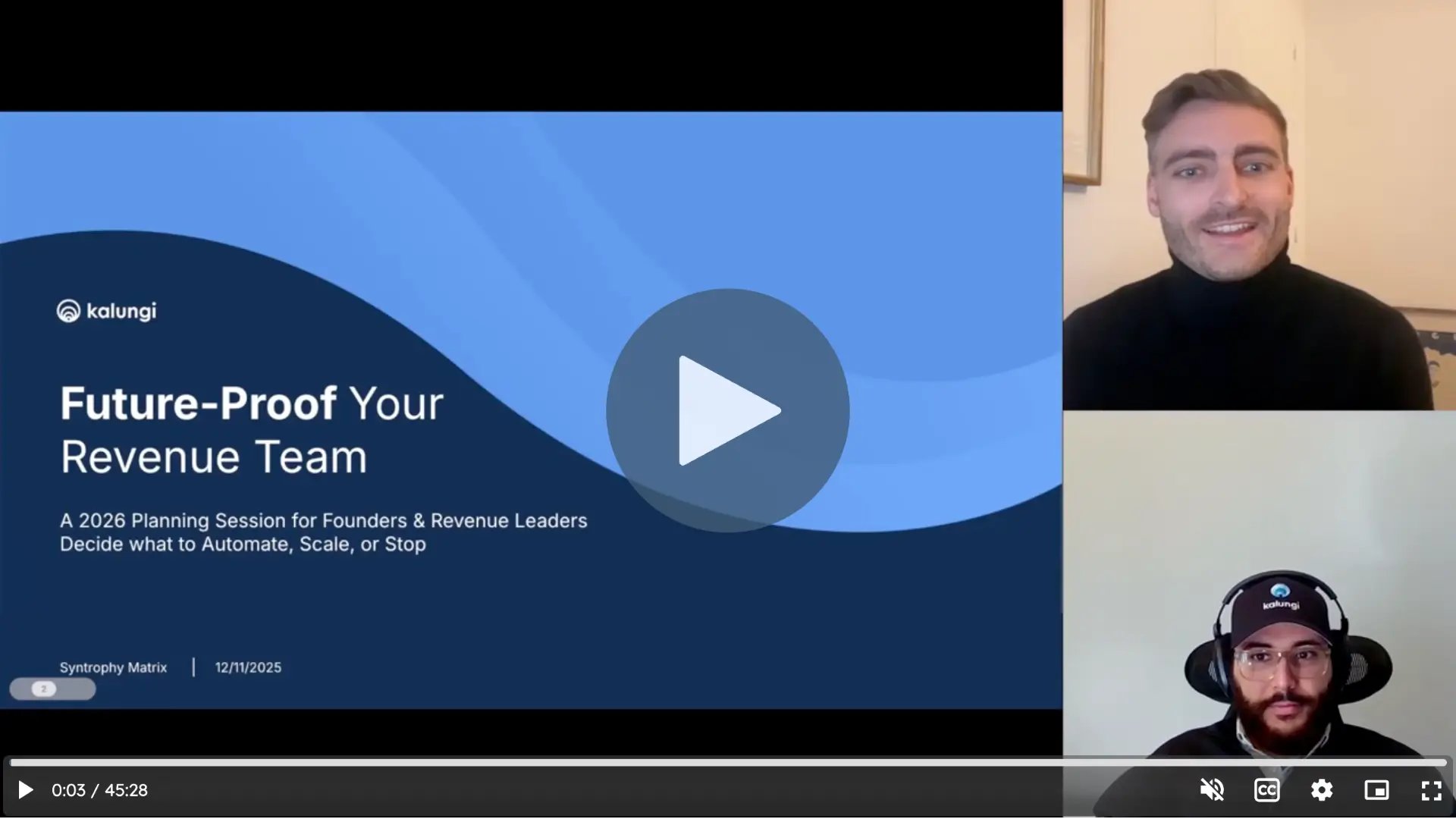
If you want to see how this exercise works in practice, Antoine and Yusuf walk through it step by step in the session “Future-Proof Your Revenue Team: A 2026 Planning Session for Founders & Revenue Leaders.”
In the recording, they:
The session is practical, opinionated, and grounded in real revenue team experience.
Watch the full training and access the free Syntropy Matrix template here: Future-Proof Your Revenue Team: A 2026 Planning Session for Founders & Revenue Leaders
Discover how B2B SaaS companies can reverse rising customer acquisition costs by adopting a more efficient, lifecycle-focused marketing strategy. ===...
Discover how scaling SaaS organizations can overcome the senior attention bottleneck to improve marketing throughput, learning velocity, and...

Whether B2B SaaS companies don’t have the time to build their first in-house team or don’t want to invest in another marketing agency selling empty...