This article is part of our GTM Motion Series, where we break down product-led, marketing-led, and sales-led growth in practical terms so you can choose the motion that fits your economics rather than chasing trends.
Product-Led Growth Is Not a Free Trial
Product-led growth is a GTM motion where your product is the primary driver of acquisition, conversion, and expansion. The user experiences value before speaking to anyone, and that experience is strong enough to justify payment and expansion without heavy persuasion. PLG is not a pricing page with a “Start for Free” button or removing sales calls or a growth hack.
If your funnel depends on marketing to generate interest and sales to convert interest into revenue, you are not product-led. If your funnel lives inside the product and revenue follows usage, you are.
The Economic Profile That Supports PLG
Product-led growth is usually a necessity when your ACV is low. If you are selling for $1,000, $2,000, or $4,000 per year, you cannot afford a heavy sales structure and you cannot rely on expensive top-of-funnel marketing to sustain growth. The math eventually catches up.
At low ACV, acquisition costs must stay controlled and cost-to-serve must remain minimal. Costs force you to design a system where users can discover value on their own and convert without multiple human interactions. If your ACV is $3,000 and your blended CAC drifts toward $1,500 because activation is weak, you have built a machine that consumes margin faster than it creates growth. At that point, scaling magnifies the problem.
Low ACV gives you very little room for inefficiency. If the product does not convert and expand on its own, no amount of marketing will rescue the economics.
PLG works best when high volume compensates for lower contract size, and when expansion inside accounts increases lifetime value over time. Without expansion, the economics become tight quickly, and without retention, they break.
If your unit economics depend on heavy outbound, account-based marketing, or long sales cycles, you are not in a product-led model, even if you offer a free trial.
The Buyer Behavior PLG Requires
Product-led growth assumes a buyer who can decide without political friction. This typically means a single decision maker or a small team with a clear mandate to adopt new tools without executive approval.
If your product requires multiple stakeholders to evaluate, budget committees to approve, or security reviews before usage, PLG becomes difficult because friction exists before value is experienced.
The ideal PLG buyer is curious, problem-aware, and comfortable experimenting independently. They do not want to schedule three calls before seeing what the product does. They want to try it, feel the benefit, and then justify the spend.
If your buyers expect guidance, reassurance, and strategic consultation before adopting, a self-serve motion makes you invisible. Deals will not convert, and you will misinterpret that as a marketing issue rather than a structural one.
The Product Requirements Are Non-Negotiable
PLG only works when the product can deliver meaningful value quickly. That does not mean a flashy dashboard or a smooth onboarding animation. It means the user reaches a clear outcome within a short timeframe and understands why it matters.
Time-to-value must be short, onboarding must be intuitive, and the “aha” moment must be obvious.
If activation takes weeks of configuration, data integration, or internal alignment, the product is not designed for PLG. You may still offer a trial, but conversion will depend on human intervention.
Expansion also needs to be designed intentionally. In a strong PLG model, initial usage naturally leads to broader adoption across users or features. If expansion requires aggressive upselling by sales, your growth engine is not product-led.
The product must do the heavy lifting.
When Product-Led Growth Works
PLG works well in narrow use cases where the pain is clear and immediate, and where value can be demonstrated without long implementation cycles. It fits tools that improve productivity, automate defined tasks, or solve specific workflow bottlenecks without requiring organizational transformation.
It also works when the founding team has strong product leadership and a culture of experimentation. Product-led companies constantly refine activation, reduce friction, and measure user behavior deeply. Without that discipline, PLG becomes a belief rather than a system.
When these conditions align, growth compounds because acquisition, conversion, and expansion are driven by usage rather than persuasion.
When Product-Led Growth Breaks
PLG breaks when companies try to force it onto complex products that require heavy integration and cross-functional buy-in. It also breaks when founders assume that removing sales automatically reduces cost without redesigning the product experience.
Another common failure appears when companies layer expensive marketing or outbound efforts on top of a low-ACV product to compensate for weak activation. That combination inflates acquisition cost while contract value remains low, which erodes margins quickly. Layering outbound on top of weak activation is one of the fastest ways to burn cash in low-ACV SaaS.
PLG also fails when expansion is an afterthought. If users sign up but do not deepen usage or invite others, growth plateaus and churn offsets new acquisition.
Offering a free plan does not make a company product-led. Designing a product that converts and expands through usage does.
Companies that force PLG onto complex products often spend months increasing traffic and signups while revenue barely moves. The team celebrates growth in users while the board questions why ARR is flat.
In venture-backed environments, PLG is often pursued because it signals scale. But if retention and expansion are not strong, you end up optimizing for vanity metrics while churn quietly erodes lifetime value. That gap eventually shows up in burn multiple.
Who Product-Led Growth Is For
PLG is best suited for early-stage or low-ACV SaaS companies whose products can deliver value independently and quickly. It fits founders who understand product deeply and are willing to invest in continuous iteration rather than relying on sales talent to close gaps.
It also fits markets where buyers prefer autonomy and where experimentation is culturally accepted.
When aligned correctly, PLG creates strong unit economics and scalable growth without building a large sales organization too early.
Who Should Avoid Product-Led Growth
If your product requires executive sponsorship before adoption, do not force a self-serve motion. You will confuse buyers and slow deals. In high-risk environments, removing human interaction will increase friction.
If your ACV is high and the perceived risk of adoption is significant, buyers will expect conversation and reassurance. In that environment, a pure self-serve approach signals immaturity rather than efficiency.
PLG is also dangerous for teams without product experimentation capability. Without constant refinement of onboarding, activation, and expansion, the model stagnates.
How Product-Led Growth Evolves as You Scale
At scale, strong PLG companies often add sales assistance, but that assistance supports expansion rather than initial acquisition. Sales becomes a multiplier for high-usage accounts instead of the engine for every new logo.
The core remains product-driven, and sales amplifies it.
If growth begins to slow, the first place to look is activation and expansion mechanics inside the product, not top-of-funnel volume.
Webinar: Designing a GTM Motion That Actually Fits Your Economics
Product-led growth creates extraordinary leverage when it fits. When it does not, it hides structural weakness behind signup volume. The difference becomes visible only when revenue fails to scale at the same pace as user growth.
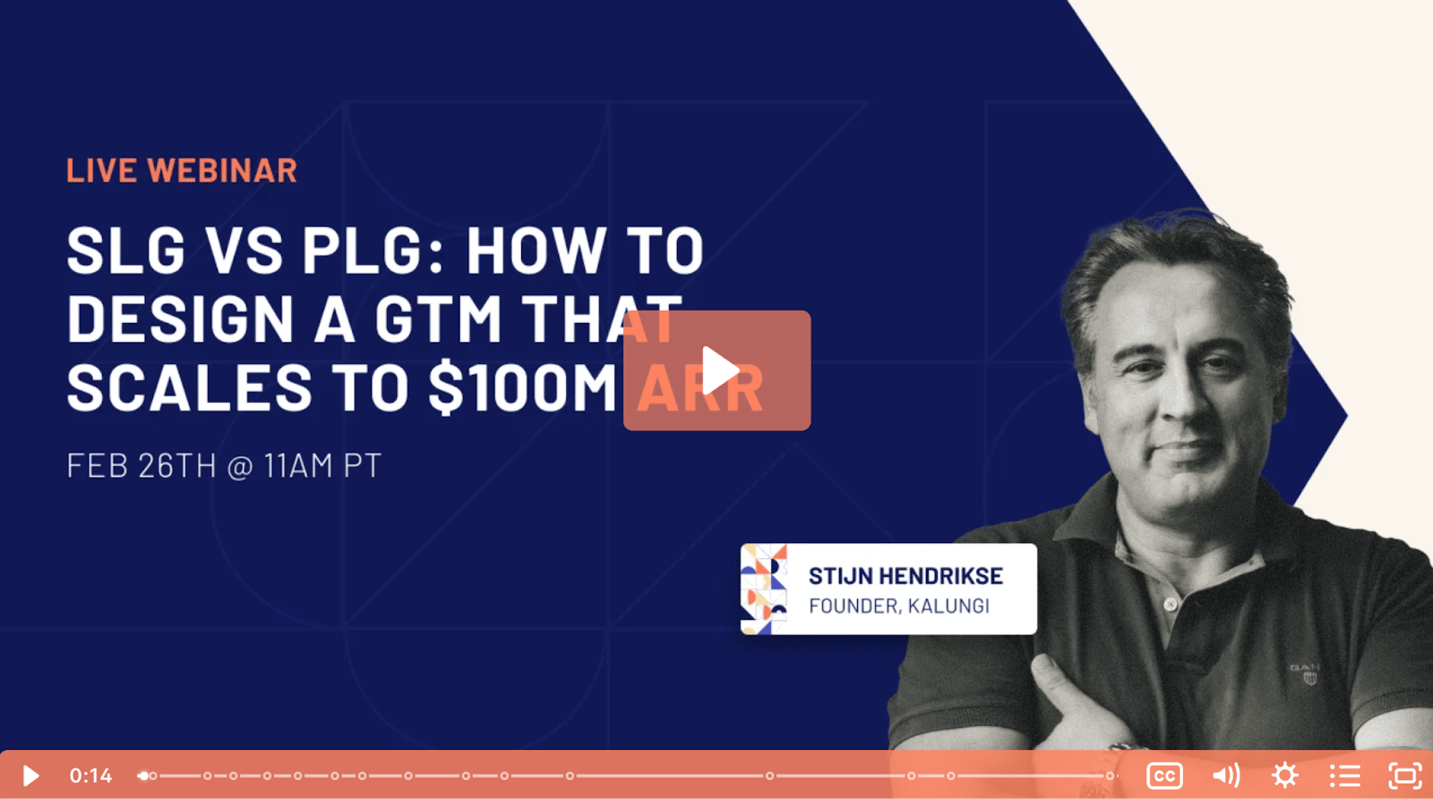
If you are evaluating whether product-led growth truly fits your SaaS, watch this webinar where Stijn Hendrikse explains how ACV, buyer behavior, and time-to-value determine whether product-led, marketing-led, or sales-led growth is structurally appropriate. The objective is alignment before scale.
The goal is to align your motion with the business you are building.
You can watch the full session here.
Ready to Pressure-Test Whether PLG Fits Your Model?
Choosing product-led growth should not be a belief-driven decision. The decision should be grounded in your ACV, retention patterns, cost structure, and product capabilities.
In our GTM workshops, we help SaaS leadership teams model whether PLG supports their economics or whether another motion would create stronger leverage at their stage.
If you are operating at low ACV or debating whether to reduce sales involvement, apply for a custom GTM workshop and pressure-test the decision before committing capital.