Demand Generation
The 3 Steps to Getting Buyers Into Your B2B SaaS Pipeline
Learn the three core steps to getting buyers into your B2B SaaS pipeline using the right offer, value-driven content, and effective distribution.


Cris S. Cubero
If you’re having qualified pipeline issues, take a look at how you’re defining your market, how you’re framing your offer, and how you’re structuring execution. When those three elements are misaligned, teams compensate with more campaigns, more outbound, more content, and more budget, but revenue doesn’t increase.
Pipeline becomes qualified when three pillars are built in the right order: Market, Offer, and Execution. If you start with execution, you are optimizing on unstable ground. If you get the first two right, execution becomes a force multiplier rather than a constant repair job.
Most ICP definitions look impressive in a slide deck and useless in practice. Industry, company size, geography, tech stack... That information describes who could buy from you, but it doesn’t describe where you win.
Your real market is the segment where your product fits naturally, where results show up quickly, and where serving customers does not require constant customization or handholding. It is the slice where sales cycles feel predictable and where customer success does not feel like firefighting.
When picking your market, start by analyzing existing customers instead of brainstorming hypothetical ones. Look at who achieved outcomes fastest, who required the least internal friction to close, and who expanded without heavy persuasion. Patterns will emerge, and those patterns define your beachhead.
A beachhead is not the biggest segment available but the segment where you already have traction and where each additional win strengthens your position. When you concentrate effort there, messaging sharpens, references multiply, and credibility grows. When you spread effort across five loosely defined ICPs, you dilute signal and slow everything down.
Under $10M in ARR, focus beats optionality. Qualified pipeline starts with density, not breadth.
Once the market is clear, the next question is simple: why should this specific buyer care enough to act?
An offer is not your feature list, your roadmap, or your differentiators. Your offer is the combination of outcome, time-to-value, required effort, and proof that makes a buyer feel confident that change is worth it.
If a prospect cannot clearly describe what improves, how quickly it improves, and what it will take on their side, hesitation is rational. We’ve seen lack of clarity kills more deals than pricing.
A strong offer makes the end state obvious and the path to get there manageable. It removes ambiguity around implementation, reduces perceived lift, and anchors the conversation in results rather than capabilities. When buyers understand the outcome and believe it will materialize within a realistic timeframe, sales friction drops naturally.
Weak offers hide behind abstract language like efficiency, optimization, or transformation. Strong offers speak in concrete terms, describe measurable improvement, and show how that improvement becomes visible in weeks rather than quarters. That level of specificity forces internal alignment inside the buyer’s organization because it gives champions something clear to defend.
If your pipeline contains many curious conversations but few decisive moves, the problem usually sits here.
Execution is where most teams focus their energy, yet execution cannot compensate for an unfocused market or an ambiguous offer. Channels amplify what already exists, but if positioning is weak, amplification spreads confusion faster.
Execution becomes powerful when it is treated as a learning engine. Every sales call, every objection, every lost deal carries information about how well your market and offer are aligned. If those signals are not captured and analyzed, the same friction repeats quarter after quarter.
Recording calls, categorizing loss reasons, reviewing stalled deals, and translating repeated objections into sharper messaging should be standard operating procedure. This is how execution strengthens the first two pillars over time.
When a particular segment converts faster, that is a market signal. When buyers consistently question implementation effort, that is an offer signal. When leads engage but fail to move to the next stage, that is an execution signal. Treating pipeline as feedback rather than volume allows you to refine targeting, clarify value, and tighten conversion without increasing spend.
Execution should make you smarter each month. If it does not, you are just producing noise.
Pull recent closed-won accounts and examine which ones delivered measurable results with minimal friction. Identify the common traits that matter, not just industry labels but behavioral and operational similarities. Reduce your ICP to a precise definition that your entire team can repeat without improvising.
Define the outcome in terms the buyer already uses internally. Specify how long it typically takes to see results and what involvement is required from their side. Add proof that feels relevant rather than generic. This becomes the foundation for your homepage, your outbound messaging, and your sales narrative.
Choose one primary motion for the next thirty days and instrument it properly. That may be focused outbound to a tightly defined account list, a webinar series targeting your beachhead, or a content push aligned to the most urgent pain you identified. What matters is not the channel choice but the discipline around capturing insight from every interaction and feeding it back into market definition and offer clarity.
This reset will come from doing fewer things with sharper alignment.
Qualified pipeline does not emerge from aggressive lead targets or creative campaign ideas. You’ll get qualified leads when the right segment recognizes itself in your message, understands the outcome you promise, and sees a believable path to achieving it.
When market focus is tight, messaging becomes specific rather than generic. When the offer is concrete, sales conversations shift from explanation to validation. When execution is disciplined, each month produces better data and sharper decisions.
If you are considering new channels, new hires, or higher spend, pressure-test the three pillars first. Ask whether your ICP is narrow enough to dominate, whether your offer removes doubt rather than creates it, and whether your execution process systematically improves understanding of both.
In SaaS, qualified pipeline is a structural outcome.
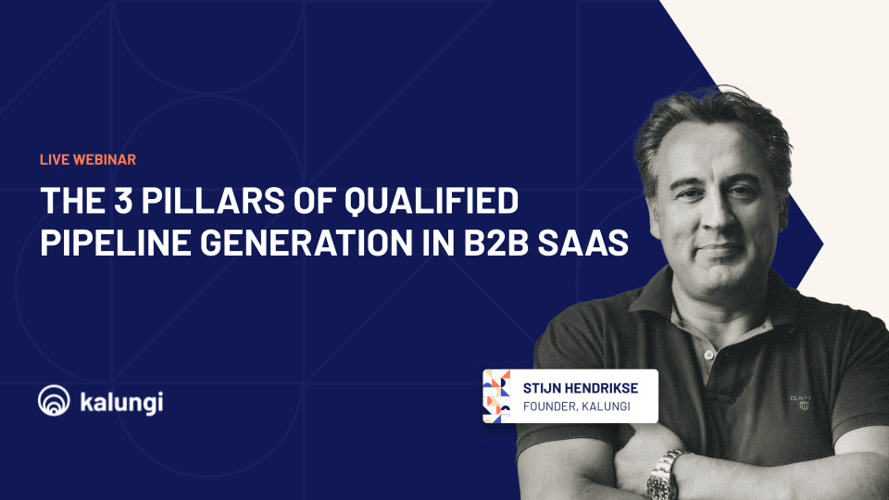
In this webinar, Stijn Hendrikse walks through how these pillars connect to the broader T2D3 growth journey and how to align them with your economics and stage of growth. The emphasis is not on tactics but on sequencing and structural alignment before scale.
If you want to go further, our GTM workshops are designed to pressure-test your market focus, sharpen your offer, and build an execution roadmap grounded in these three pillars. Apply for a personalized GTM workshop here.

Learn the three core steps to getting buyers into your B2B SaaS pipeline using the right offer, value-driven content, and effective distribution.
Building a successful B2B SaaS referral program will help you grow a stronger userbase and increase revenue while rewarding your existing loyal...

Learn how to use webinars in B2B SaaS to build trust at scale, engage target accounts, and turn value-first education into real pipeline growth.