Strategy & Planning
Moving upmarket from SMB to enterprise for SaaS: when and how
What does moving upmarket look like and what does it entail? How are SMB and enterprise different?


Cris S. Cubero
For some SaaS teams, the automation conversation starts in the wrong place. The first question is usually technical: Can this be automated? The answer, increasingly, is yes. AI tools exist for almost every workflow. AI can research, summarize, draft, enrich, route, and report at a speed no human can match.
And that is precisely the problem.
When everything can be automated, technical feasibility stops being a useful filter. Speed alone does not create leverage. In many cases, it amplifies confusion by accelerating work that should not have existed in the first place because AI makes whatever you are already doing happen faster. If the work is low-signal, you simply get to low-signal outcomes more quickly.
The real decision SaaS leaders need to make is not what to automate, but where human judgment actually belongs.
Let’s make a distinction that reframed the entire automation conversation.
The issue is not whether a task can be done by AI but whether that task deserves sustained human attention. Many teams still have people spending hours on work that “should have died with the fax machine” because no one has stopped to question its value.
Automation goes wrong because SaaS teams automate what is easiest to automate, not what is safest to automate. They protect work that feels familiar rather than work that creates differentiation. And they organize around tools instead of outcomes.
A better starting point is to ask two simpler, harder questions:
Once those questions are made explicit, automation decisions become clearer, and mistakes become easier to avoid.
Some work is essential, but repetitive. It needs to happen consistently, yet it rarely benefits from repeated human judgment.
Lead enrichment and routing is a clear example. Setting the rules requires human input. Someone needs to define what qualifies as a lead, how routing works, and when exceptions apply. But once those decisions are made, having a human repeatedly enrich records or assign leads adds little value. This is work that is highly relevant, but low in ongoing judgment.
The same applies to reporting production. No CRM produces a report that can be used immediately, but assembling the data itself does not require a human every time. Pulling numbers, formatting dashboards, and generating recurring views are mechanical tasks. Automating them frees time without eroding decision quality.
The thinking pattern here matters more than the example. If a task requires judgment once, but repetition thereafter, it is a strong candidate for automation. The question for leaders becomes: Where are we making the same decision over and over again, when a system could enforce it instead?
Not all work falls neatly into “automate” or “protect.” Some workflows benefit from partial automation, but degrade quickly when judgment is removed entirely.
Post-meeting follow-ups are a good illustration. Transcription is an obvious win for automation, summaries can be drafted by AI, and even suggested action items can be generated, but deciding what actually matters from a conversation, who should be looped in, what tone is appropriate, and what should happen next requires context. That context lives with the human.
SEO keyword research works in a similar way. Tools can surface keywords, volumes, and competitive gaps far faster than a person ever could. But deciding which keywords matter, which ones align with positioning, and which ones are worth investing in is not a technical decision but a strategic one.
In these cases, the typical mistake we see SaaS teams make is failing to decompose the work. When leaders break workflows into steps and ask which steps require context, judgment, or taste, automation becomes supportive rather than destructive.
Some work should remain explicitly human, even in an AI-saturated environment. Founder-led messaging, positioning, pricing decisions, sales coaching, and complex negotiations all sit in this category.
AI can assist with research, summarize competitors, surface patterns, and generate options, but what it cannot do is understand perceived value, organizational nuance, or the psychology of a buyer in context. Those decisions are not just hard to automate; automating them actively erodes differentiation.
A useful test here is simple. If a competitor copied this process tomorrow, would it weaken your position? If the answer is yes, the work likely belongs with humans. This is the work that makes a company hard to copy, and it deserves protection.
We’ve noticed SaaS teams want to automate reporting before fixing data quality, scale content before clarifying positioning, add tools before aligning on outcomes… In doing so, they move faster while lowering signal.
This is a prioritization problem. Automation magnifies whatever structure already exists. If judgment is misallocated before AI enters the picture, AI will magnify that misallocation.
The SaaS teams that succeed are the ones that deliberately decide what work deserves attention, and then use automation to defend that decision.
The job of a SaaS leader is to reassign judgment and redistribute focus. Automation is a lever for this, not a strategy.
When leaders make judgment allocation explicit, several things happen at once. Low-value work becomes easier to remove, automation decisions feel defensible rather than speculative, and high-signal work stops getting buried under operational noise.
That is when speed becomes an advantage instead of a liability.
The challenge, of course, is doing this systematically rather than instinctively. This is where the Syntropy Matrix comes in.
The Syntropy Matrix is a way to map the work teams already do and evaluate it along two dimensions: how much human judgment it requires, and how relevant it is to real outcomes. When teams see their tasks plotted this way, patterns surface quickly, automation opportunities become obvious, protected work becomes clearer, and legacy tasks lose their grip.
Most importantly, the conversation changes. Decisions about what to automate, what to scale, and what to stop become structural and informed.
.png?width=1920&height=1080&name=syntropy%20matrix%20(1).png)
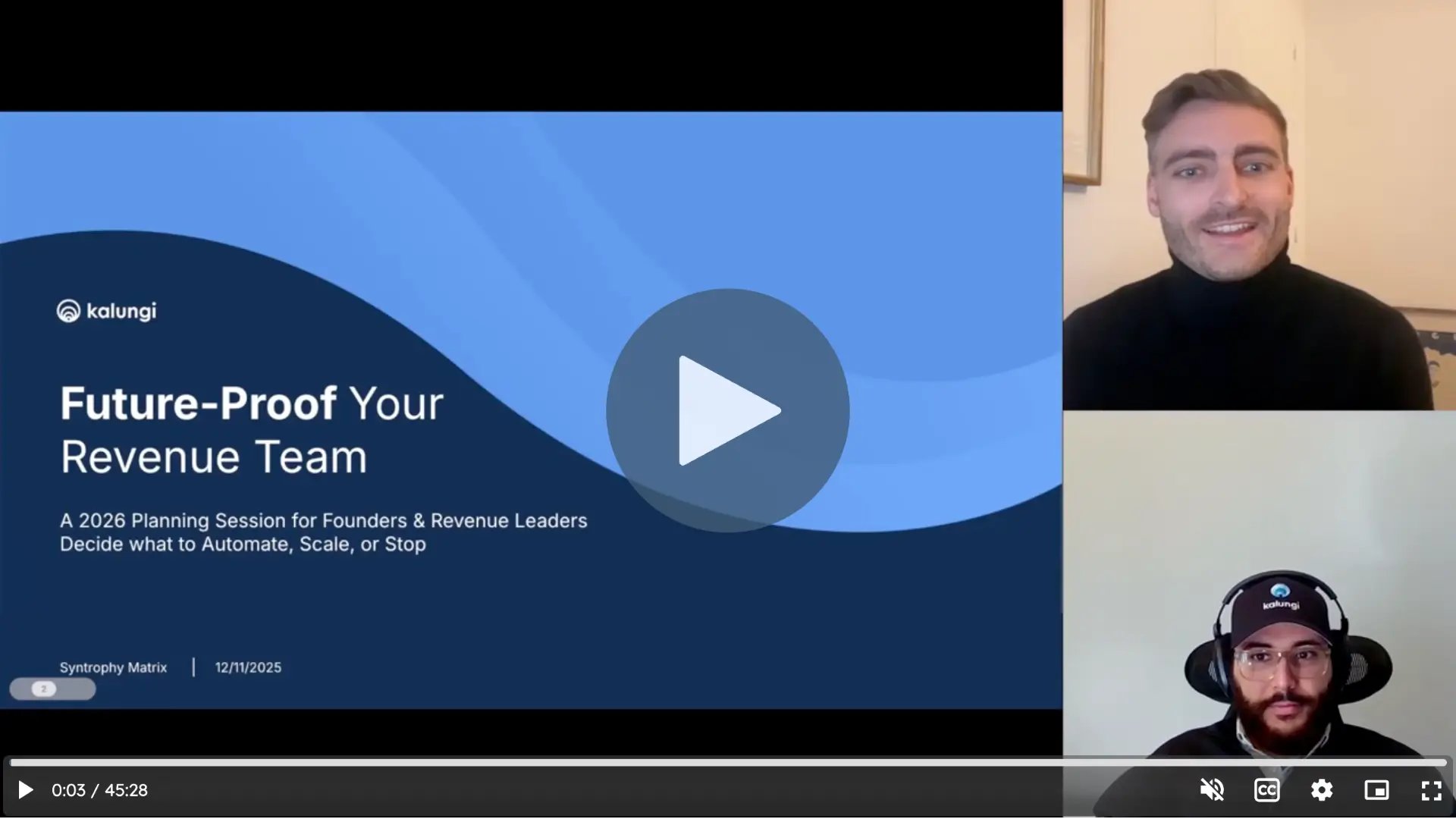
Antoine and Yusuf walk through this exact decision process in the session “Future-Proof Your Revenue Team: A 2026 Planning Session for Founders & Revenue Leaders.” In the training, they show how teams use the Syntropy Matrix to decide what should be automated, what should remain human, and what should stop entirely.
In the recording, they:
Watch the full training and access the free Syntropy Matrix template here: Future-Proof Your Revenue Team: A 2026 Planning Session for Founders & Revenue Leaders
What does moving upmarket look like and what does it entail? How are SMB and enterprise different?
Discover why SEO is a growth engine for SaaS businesses. Learn how it evolves through different growth stages and its key pillars of success.

Not sure whether to hire a SaaS marketing agency or a fractional CMO? Learn the difference, when each makes sense, and how to decide.