Sales
Your Forecast Didn't Slip on Budget. It Slipped on Proof.
B2B SaaS deals stall on proof, not budget. The four levels of evidence buyers trust, and how to fix your proof gap.


Cris S. Cubero
AI entered revenue teams with a simple promise: remove friction. Fewer manual tasks, faster execution, better decisions. And for leaders already running lean organizations under constant pressure, the appeal was obvious. AI was not positioned as an experiment, but as a necessary evolution in how work gets done.
What followed has been more complicated. AI delivered speed, but not relief. Output increased, yet clarity did not. And in many organizations, leaders now find themselves managing more activity with less confidence, wondering why something that was supposed to simplify work seems to have exposed new forms of friction instead.
These pains are not the result of failed adoption but the result of acceleration without reconsideration.
AI was expected to make work visible. With automated reporting, summaries, and dashboards, leaders assumed they would finally gain a clearer picture of how effort flows through the organization.
In reality, most leaders still cannot say how their teams spend a typical week. Very few founders or revenue leaders have ever mapped the actual tasks their teams perform. AI did not fix that. It simply helped teams do more work inside an already opaque system.
The pain here is subtle but destabilizing. Leaders sense inefficiency, yet lack the confidence to intervene. Without visibility into how judgment is allocated, prioritization becomes random, and every decision carries more risk than it should.
Automation was supposed to free talented people from low-value work so they could focus on strategy, creativity, and high-impact decisions.
Instead, many teams continue to rely on humans for tasks that require attention but not insight. Manual research, content cleanup, reporting adjustments, coordination overhead… Work that consumes mental energy without delivering proportional value. Ask yourself, is your people doing work that actually deserves their brains?
This creates a specific kind of fatigue. Not the exhaustion of overwork, but the frustration of misused capability. Leaders recognize it when their strongest people disengage quietly, yet struggle to fix it without a shared way to decide what work should remain human.
One of the strongest selling points of AI was workload reduction. Faster execution, fewer manual steps, and more output with the same team.
What many organizations experienced instead was accumulation. New tools required setup, oversight, and exception handling, old processes stayed in place, and expectations rose as soon as speed became visible. AI ended up being layered on top of existing workflows rather than replacing them.
The result is a team that moves faster while feeling more constrained. Leaders struggle to explain why productivity gains have not translated into breathing room. Work accelerates, but pressure does not ease.
AI was meant to solve the content bottleneck. Blogs, landing pages, and sales assets could be produced faster, at scale, without draining the team.
Volume did increase, but signal didn’t. Much of the SaaS content that circulates today lacks substance. AI produces competent output, but rarely distinctive insight, shifting the burden back onto humans to edit, contextualize, and inject judgment.
The pain is not that content fails outright but that it blends in. Teams spend more time correcting or humanizing AI-generated work than expected, while worrying about the long-term impact on brand credibility.
AI tools are relatively inexpensive in isolation, which made experimentation easy. Leaders approved subscriptions expecting leverage.
Over time, that confidence eroded. Without clarity on which tasks tools actually replaced, ROI became harder to defend. Speeding up the wrong work simply makes mistakes more expensive.
The pain here is not overspending but uncertainty. Leaders hesitate to invest further, but also fear falling behind, caught between action and restraint with no clear framework to guide them.
Automation was supposed to improve decision-making by producing reliable data and insights.
In practice, reports still require interpretation. No CRM produces a report that can be used without context. Automation often surfaces inconsistencies rather than resolving them, forcing leaders to double-check outputs before acting.
This undermines confidence. Instead of accelerating decisions, automation introduces hesitation. Teams revert to manual validation or instinct, neutralizing the very gains AI was meant to deliver.
AI was expected to modernize workflows and eliminate outdated processes.
Yet much work continues simply because it always has. Operational clutter accumulates quietly, reinforced by habit rather than relevance. This is work that creates little value but persists because it feels risky to challenge.
The pain is not inefficiency alone. It’s the lack of a neutral way to stop work without making it personal. Without shared criteria, leaders default to tolerance, and clutter compounds.
AI adoption came with an implicit warning: move or be left behind. For many leaders, that urgency is real.
At the same time, there is a growing fear that moving too fast could erode the judgment, nuance, and positioning that differentiate the business. Speed promises relevance but indiscriminate automation threatens it.
This tension leaves teams oscillating between urgency and caution, unsure how to advance without compromising what matters most.
Taken together, these pains create a leadership dilemma. Leaders sense that the current way of working is unsustainable, yet adding more AI tools or pushing harder no longer feels like progress.
AI did not provide a map, it actually exposed the absence of one.
The main pain we’re feeling is the lack of a grounded, defensible way to decide how work should change.
SaaS teams making progress are not chasing more automation. They are slowing down just enough to make explicit decisions about where human judgment belongs, which work should be systemized, and what should stop entirely.
Instead of asking what can be automated, they ask what deserves attention. That shift in mindset restores clarity, and once clarity exists, speed becomes an advantage rather than a liability.
What all of these pains have in common is not AI itself, but the absence of a shared way to decide how work should change once AI enters the system.
Most teams adopted AI by asking tactical questions first. What can we automate? Which tools should we try? How do we move faster? Those questions feel practical, but they skip a more fundamental one: where should human judgment actually be spent?
This is the gap the Syntropy Matrix is designed to close.
.png?width=1920&height=1080&name=syntropy%20matrix%20(1).png)
Rather than starting with tools or workflows, the Syntropy Matrix forces teams to map the work they already do and evaluate it along two simple dimensions: how much human judgment it requires, and how much real value it creates. When teams see their work plotted this way, patterns become difficult to ignore. High-value judgment is often buried under low-impact tasks. Work that feels “necessary” turns out to be legacy habit. Automation opportunities become obvious, not theoretical.
More importantly, the conversation changes. Decisions about what to automate, what to scale, and what to stop become structural. Teams stop debating tools in the abstract and start agreeing on priorities in concrete terms.
For leaders who feel stuck between moving too fast and not moving at all, this shift is key. It replaces anxiety with a defensible way to reassign attention without disrupting delivery.
The Syntropy Matrix does not promise instant transformation. What it offers instead is something more valuable: a way to make deliberate decisions about work in an environment where speed alone is no longer an advantage.
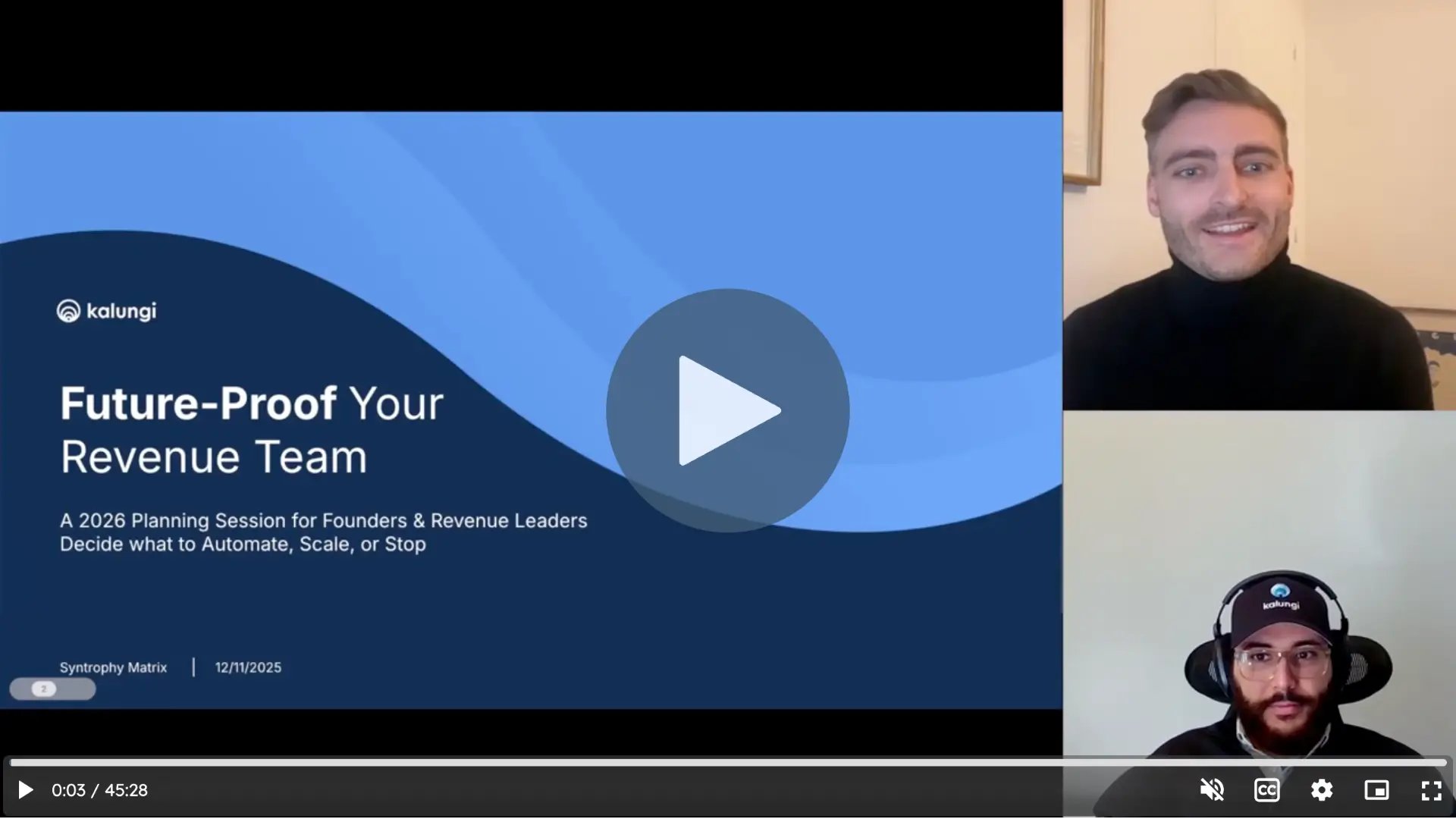
Antoine and Yusuf walk through this exercise in the session “Future-Proof Your Revenue Team: A 2026 Planning Session for Founders & Revenue Leaders.” In the training, they show how revenue teams use the Syntropy Matrix to surface these pains, make tradeoffs visible, and decide what to automate, what to scale, and what should stop.
In the recording, they:
Watch the full training and access the free Syntropy Matrix template here: Future-Proof Your Revenue Team: A 2026 Planning Session for Founders & Revenue Leaders

B2B SaaS deals stall on proof, not budget. The four levels of evidence buyers trust, and how to fix your proof gap.
Discover the future of work as AI reshapes roles, creating a divide between entropy processors and syntropy creators who add irreplaceable value.

Here are some basic rules for when you consider discounting your SaaS products or services. When you discount your SaaS Pricing, what did you get in...